'%3e%3cpath%20d='M12.0683%2015.2949H11.015C10.9053%2015.2949%2010.8164%2015.3838%2010.8164%2015.4935V25.7849C10.8164%2025.8946%2010.9053%2025.9835%2011.015%2025.9835H12.0683C12.1779%2025.9835%2012.2668%2025.8946%2012.2668%2025.7849V15.4935C12.2668%2015.3838%2012.1779%2015.2949%2012.0683%2015.2949Z'%20fill='%230048FF'/%3e%3cpath%20d='M15.0278%2015.2949H13.9915C13.8819%2015.2949%2013.793%2015.3838%2013.793%2015.4935V25.7849C13.793%2025.8946%2013.8818%2025.9835%2013.9915%2025.9835H15.0278C15.1374%2025.9835%2015.2263%2025.8946%2015.2263%2025.7849V15.4935C15.2263%2015.3838%2015.1374%2015.2949%2015.0278%2015.2949Z'%20fill='%230048FF'/%3e%3cpath%20d='M9.09443%2015.2949H1.71809C1.60845%2015.2949%201.51953%2015.3838%201.51953%2015.4935V21.6128C1.51953%2024.0267%203.47634%2025.9834%205.89013%2025.9834H9.09448C9.20412%2025.9834%209.29304%2025.8946%209.29304%2025.7849V15.4935C9.29299%2015.3838%209.20407%2015.2949%209.09443%2015.2949Z'%20fill='%230048FF'/%3e%3cpath%20d='M24.342%2015.2949H16.9486C16.8389%2015.2949%2016.75%2015.3838%2016.75%2015.4935V25.7849C16.75%2025.8946%2016.8389%2025.9835%2016.9486%2025.9835H20.17C22.5838%2025.9835%2024.5406%2024.0267%2024.5406%2021.6129V15.4935C24.5406%2015.3838%2024.4517%2015.2949%2024.342%2015.2949Z'%20fill='%230048FF'/%3e%3cpath%20d='M15.016%206.07227H13.9798C13.8702%206.07227%2013.7812%206.16113%2013.7812%206.27082V13.6882C13.7812%2013.7978%2013.8701%2013.8868%2013.9798%2013.8868H15.016C15.1257%2013.8868%2015.2146%2013.7979%2015.2146%2013.6882V6.27077C15.2146%206.16113%2015.1257%206.07227%2015.016%206.07227Z'%20fill='%230048FF'/%3e%3cpath%20d='M12.0605%206.07227H11.0071C10.8975%206.07227%2010.8086%206.16113%2010.8086%206.27082V13.6882C10.8086%2013.7978%2010.8975%2013.8868%2011.0071%2013.8868H12.0605C12.1701%2013.8868%2012.259%2013.7979%2012.259%2013.6882V6.27077C12.259%206.16113%2012.1701%206.07227%2012.0605%206.07227Z'%20fill='%230048FF'/%3e%3cpath%20d='M23.5711%206.07227H16.9368C16.8272%206.07227%2016.7383%206.16113%2016.7383%206.27082V13.6882C16.7383%2013.7978%2016.8271%2013.8868%2016.9368%2013.8868H23.571C24.9125%2013.8868%2025.9999%2012.7993%2025.9999%2011.4578V8.50119C26%207.1597%2024.9125%206.07227%2023.5711%206.07227Z'%20fill='%230048FF'/%3e%3cpath%20d='M9.08494%206.07227H2.42892C1.08748%206.07221%200%207.15965%200%208.50114V11.4577C0%2012.7992%201.08748%2013.8867%202.42892%2013.8867H9.08494V13.8867C9.19457%2013.8867%209.28349%2013.7978%209.28349%2013.6881V6.27077C9.28349%206.16113%209.19457%206.07227%209.08494%206.07227Z'%20fill='%230048FF'/%3e%3cpath%20d='M20.1871%201.47349C18.9897%20-0.129579%2016.7113%20-0.459759%2015.1081%200.737715C14.8681%200.916974%2014.1377%201.46252%2013.1094%204.1681C13.109%204.16937%2013.1084%204.17064%2013.1079%204.17191C13.0397%204.35157%2013.173%204.54383%2013.3652%204.54383H20.6349C20.7291%204.54383%2020.8107%204.47766%2020.8298%204.38539C21.0343%203.40226%2020.8339%202.33941%2020.1871%201.47349Z'%20fill='%230048FF'/%3e%3cpath%20d='M12.4378%202.93607C11.6806%201.28298%2011.1489%200.885569%2010.9508%200.737694C9.34772%20-0.459731%207.06926%20-0.129601%205.87183%201.47346C5.22508%202.33944%205.02465%203.40224%205.22915%204.38542C5.24834%204.47764%205.32979%204.54386%205.42404%204.54386H11.7223C11.8052%204.54386%2011.8796%204.49231%2011.9084%204.41447C11.9384%204.33311%2011.9691%204.2509%2012.0006%204.16808C12.1533%203.76609%2012.2995%203.41209%2012.4385%203.09953C12.4616%203.04748%2012.4615%202.98792%2012.4378%202.93607Z'%20fill='%230048FF'/%3e%3c/g%3e%3cdefs%3e%3cclipPath%20id='clip0_4773_3494'%3e%3crect%20width='26'%20height='26'%20fill='white'/%3e%3c/clipPath%3e%3c/defs%3e%3c/svg%3e)
Free ad placement
EN


Free ad placement

Goods, services, cars, real estate and jobs

Create a seller page

EN



0

17

0



ТОО "Helio Solar"
Helio Solar is a company in the field of solar energy and renewable energy, which is engaged in the supply, design, installation and maintenance of solar power plants for businesses, private facilities and industrial enterprises in Kazakhstan.
When a business, homeowner or industrial facility compares solar panels, the question is rarely only about the price of one module. The real decision is how much energy the whole solar power plant can produce on the available area, how the panels behave in heat, how many mounting elements are needed and whether the selected technology matches the inverter and future expansion plan. ТОО Helio Solar works with supply, design, installation and maintenance of solar power plants, so the choice between monocrystalline and polycrystalline panels should be based on project calculations, not on a simple label.
The core difference: crystal structure and energy density
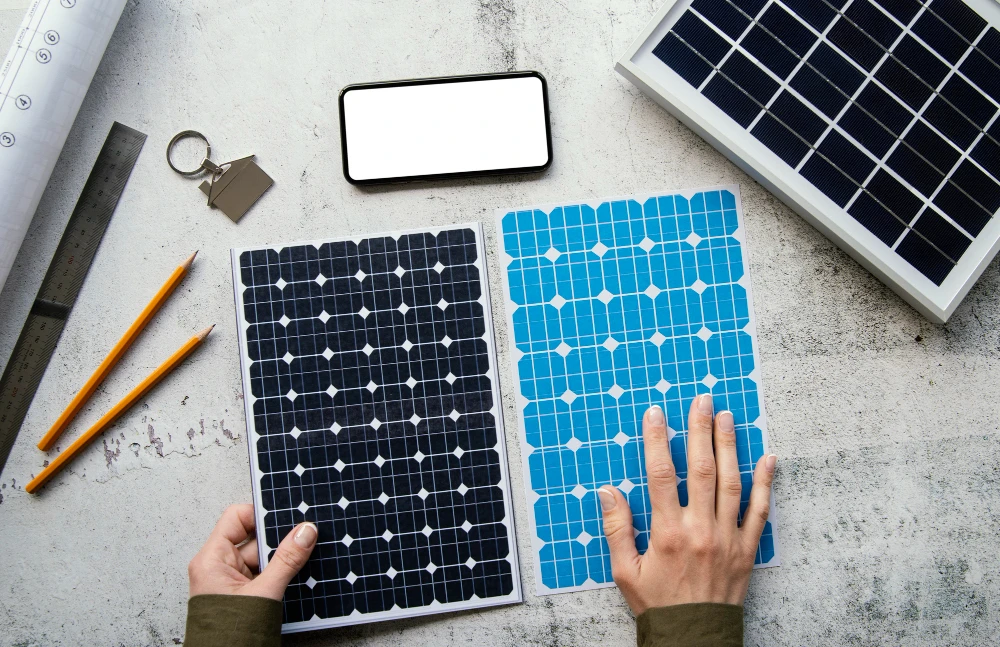
Monocrystalline solar panels are made from a single-crystal silicon structure. This gives the module a more uniform internal architecture and usually allows higher conversion efficiency. Polycrystalline panels are made from multiple silicon crystals, so their internal structure is less uniform and their efficiency is usually lower.
For the customer, the difference is practical: monocrystalline panels can generate more power from the same roof or land area. This matters for houses, warehouses, office roofs, industrial buildings and carport systems where ventilation units, parapets, service paths and shaded zones already reduce usable space. Basic information about the supplier is available in the Helio Solar company profile on Mytrade.kz.
Efficiency: why a few percent change the whole layout
Modern commercial monocrystalline modules are often in the range of about 20–22% efficiency, while many older or budget polycrystalline modules are typically lower. In high-efficiency mono segments such as n-type, TOPCon or HJT, the numbers can be higher, but the exact value must always be checked in the module datasheet.
A simple area calculation shows why this matters. To install 10 kW of panel capacity, modules with 22% efficiency need roughly 45–46 m² of active panel area. At 17% efficiency, the same capacity may require about 58–59 m² before service gaps, roof setbacks and shading losses are added. That extra area can change the mounting scheme, cable length, roof loading and total installation cost.
Useful figures for a first comparison
- Typical modern mono module efficiency: around 20–22% in many commercial products.
- Typical poly module efficiency: often around 15–18%, depending on age and manufacturer.
- Power density: mono modules often provide about 200–220 W/m², while poly modules are commonly lower.
- Area difference for 10 kW: the gap can reach 10–15 m² on real projects.
- Hidden cost risk: cheaper panels may require more mounting structure, cable, protection devices and installation work.
Before ordering, it is better to compare not only panel type but also inverter compatibility, mounting system, protection equipment and service requirements. Available equipment and service options can be reviewed through the current solar energy offers from the company.
Heat, dust and real operating conditions in Kazakhstan
Panel efficiency in a datasheet is measured under standard test conditions, but a solar power plant works under real weather. In Kazakhstan, modules may face summer heat, winter snow, strong wind, dust and seasonal contamination. Silicon modules lose part of their power as cell temperature rises; many datasheets show a temperature coefficient roughly between -0.29% and -0.45% per degree above the standard reference level.
This is why the final choice cannot be made only by comparing nominal watts. A panel with higher efficiency but poor temperature behavior may not always deliver the expected advantage in hot conditions. Kazakhstan has strong photovoltaic potential: Global Solar Atlas indicates a specific PV power output range of about 3.17–4.30 kWh/kWp per day across the country. Related materials on solar power plant selection and operation are published in the seller’s news and offers section.
When monocrystalline panels are usually the stronger choice
Monocrystalline panels are often more suitable when the available area is limited and the customer needs maximum installed capacity. This is common for private houses with compact roofs, commercial buildings with engineering equipment on top, warehouses with limited south-facing zones, and industrial facilities where service access must remain open.
Mono panels are also more relevant when the project may later be expanded, connected to batteries or upgraded into a hybrid system. Global manufacturing trends support this direction: IEA PVPS reports that n-type technologies represent around 70% of global production, while bifacial modules account for more than 75% of production. Visual examples and company updates can be viewed in the Helio Solar Reels videos.
When polycrystalline panels can still make sense
Polycrystalline panels should not be rejected automatically. They may be considered when there is enough free area, the roof or ground structure can accept a larger array, and the project is highly sensitive to upfront equipment cost. For example, a technical ground area or an open site may allow more rows without creating layout problems.
However, the customer should check the full system cost, not only the panel price. If the lower-efficiency option requires additional mounting rails, more cable, more connectors, longer installation work and a larger footprint, the apparent saving can become smaller. It is also important to review the production year, degradation rate, mechanical load, temperature coefficient and inverter compatibility. To compare different video formats and market examples, users can browse the short video section on Mytrade.kz.
What to check before choosing panel technology
ТОО Helio Solar approaches panel selection through the whole solar power plant design. The starting point is not “mono or poly”, but the customer’s electricity consumption, load profile, roof orientation, available area, shading, inverter voltage range, cable route and access for maintenance. Only after this analysis does it become clear whether higher-efficiency modules justify their cost.
Key points for a commercial proposal
- Rated power of one module and total planned DC capacity.
- Module efficiency and actual area required for the array.
- Temperature coefficient and expected output in hot months.
- Compatibility with the inverter by voltage and current range.
- Roof load, wind load, mounting system and service access.
- Estimated annual generation for the specific location and tilt angle.
- Total plant cost, including mounting, cable, protection equipment, installation and maintenance.
For customers comparing suppliers, services and company showcases in one place, the Mytrade.kz marketplace provides a convenient starting point.
The right panel is the one confirmed by calculation
If roof area is limited, energy density is important and the solar power plant may be expanded later, monocrystalline panels are usually the more practical option. If the site has enough space and the project is focused on reducing the initial equipment budget, polycrystalline panels can still be included in the comparison. The final decision should come from a technical and economic calculation, not from a general assumption that one technology is always better.
ТОО Helio Solar works with solar power plants for private, commercial and industrial facilities in Kazakhstan, including supply, design, installation and maintenance. Before selecting panel technology, it is also important to check the factors that affect the efficiency of the whole plant: orientation, shading, temperature, pollution, inverter selection and installation quality. These points are reviewed in the previous article about solar power plant efficiency factors.