'%3e%3cpath%20d='M12.0683%2015.2949H11.015C10.9053%2015.2949%2010.8164%2015.3838%2010.8164%2015.4935V25.7849C10.8164%2025.8946%2010.9053%2025.9835%2011.015%2025.9835H12.0683C12.1779%2025.9835%2012.2668%2025.8946%2012.2668%2025.7849V15.4935C12.2668%2015.3838%2012.1779%2015.2949%2012.0683%2015.2949Z'%20fill='%230048FF'/%3e%3cpath%20d='M15.0278%2015.2949H13.9915C13.8819%2015.2949%2013.793%2015.3838%2013.793%2015.4935V25.7849C13.793%2025.8946%2013.8818%2025.9835%2013.9915%2025.9835H15.0278C15.1374%2025.9835%2015.2263%2025.8946%2015.2263%2025.7849V15.4935C15.2263%2015.3838%2015.1374%2015.2949%2015.0278%2015.2949Z'%20fill='%230048FF'/%3e%3cpath%20d='M9.09443%2015.2949H1.71809C1.60845%2015.2949%201.51953%2015.3838%201.51953%2015.4935V21.6128C1.51953%2024.0267%203.47634%2025.9834%205.89013%2025.9834H9.09448C9.20412%2025.9834%209.29304%2025.8946%209.29304%2025.7849V15.4935C9.29299%2015.3838%209.20407%2015.2949%209.09443%2015.2949Z'%20fill='%230048FF'/%3e%3cpath%20d='M24.342%2015.2949H16.9486C16.8389%2015.2949%2016.75%2015.3838%2016.75%2015.4935V25.7849C16.75%2025.8946%2016.8389%2025.9835%2016.9486%2025.9835H20.17C22.5838%2025.9835%2024.5406%2024.0267%2024.5406%2021.6129V15.4935C24.5406%2015.3838%2024.4517%2015.2949%2024.342%2015.2949Z'%20fill='%230048FF'/%3e%3cpath%20d='M15.016%206.07227H13.9798C13.8702%206.07227%2013.7812%206.16113%2013.7812%206.27082V13.6882C13.7812%2013.7978%2013.8701%2013.8868%2013.9798%2013.8868H15.016C15.1257%2013.8868%2015.2146%2013.7979%2015.2146%2013.6882V6.27077C15.2146%206.16113%2015.1257%206.07227%2015.016%206.07227Z'%20fill='%230048FF'/%3e%3cpath%20d='M12.0605%206.07227H11.0071C10.8975%206.07227%2010.8086%206.16113%2010.8086%206.27082V13.6882C10.8086%2013.7978%2010.8975%2013.8868%2011.0071%2013.8868H12.0605C12.1701%2013.8868%2012.259%2013.7979%2012.259%2013.6882V6.27077C12.259%206.16113%2012.1701%206.07227%2012.0605%206.07227Z'%20fill='%230048FF'/%3e%3cpath%20d='M23.5711%206.07227H16.9368C16.8272%206.07227%2016.7383%206.16113%2016.7383%206.27082V13.6882C16.7383%2013.7978%2016.8271%2013.8868%2016.9368%2013.8868H23.571C24.9125%2013.8868%2025.9999%2012.7993%2025.9999%2011.4578V8.50119C26%207.1597%2024.9125%206.07227%2023.5711%206.07227Z'%20fill='%230048FF'/%3e%3cpath%20d='M9.08494%206.07227H2.42892C1.08748%206.07221%200%207.15965%200%208.50114V11.4577C0%2012.7992%201.08748%2013.8867%202.42892%2013.8867H9.08494V13.8867C9.19457%2013.8867%209.28349%2013.7978%209.28349%2013.6881V6.27077C9.28349%206.16113%209.19457%206.07227%209.08494%206.07227Z'%20fill='%230048FF'/%3e%3cpath%20d='M20.1871%201.47349C18.9897%20-0.129579%2016.7113%20-0.459759%2015.1081%200.737715C14.8681%200.916974%2014.1377%201.46252%2013.1094%204.1681C13.109%204.16937%2013.1084%204.17064%2013.1079%204.17191C13.0397%204.35157%2013.173%204.54383%2013.3652%204.54383H20.6349C20.7291%204.54383%2020.8107%204.47766%2020.8298%204.38539C21.0343%203.40226%2020.8339%202.33941%2020.1871%201.47349Z'%20fill='%230048FF'/%3e%3cpath%20d='M12.4378%202.93607C11.6806%201.28298%2011.1489%200.885569%2010.9508%200.737694C9.34772%20-0.459731%207.06926%20-0.129601%205.87183%201.47346C5.22508%202.33944%205.02465%203.40224%205.22915%204.38542C5.24834%204.47764%205.32979%204.54386%205.42404%204.54386H11.7223C11.8052%204.54386%2011.8796%204.49231%2011.9084%204.41447C11.9384%204.33311%2011.9691%204.2509%2012.0006%204.16808C12.1533%203.76609%2012.2995%203.41209%2012.4385%203.09953C12.4616%203.04748%2012.4615%202.98792%2012.4378%202.93607Z'%20fill='%230048FF'/%3e%3c/g%3e%3cdefs%3e%3cclipPath%20id='clip0_4773_3494'%3e%3crect%20width='26'%20height='26'%20fill='white'/%3e%3c/clipPath%3e%3c/defs%3e%3c/svg%3e)
Free ad placement
EN


Free ad placement

Goods, services, cars, real estate and jobs

Create a seller page

EN



0

10

0




ТОО "Helio Solar"
Helio Solar is a company in the field of solar energy and renewable energy, which is engaged in the supply, design, installation and maintenance of solar power plants for businesses, private facilities and industrial enterprises in Kazakhstan.
When planning a solar power plant, most investors focus on equipment costs and expected electricity production. However, actual system performance depends just as much on local climate conditions. Kazakhstan's vast territory includes deserts, steppes, mountain regions and areas with long snowy winters, meaning every project must account for environmental factors that directly influence energy generation. Considering temperature, dust accumulation, snowfall and wind loads during the design stage helps improve long-term efficiency, reliability and return on investment.
Kazakhstan offers strong potential for solar energy development
According to international renewable energy studies, Kazakhstan receives approximately 2,200 to 3,000 hours of sunshine annually across most regions. Average annual solar irradiation ranges between 1,300 and more than 1,800 kWh per square meter, placing the country among the most promising locations for photovoltaic projects in Central Asia.
Nevertheless, high solar irradiation alone does not guarantee identical electricity production throughout the year. Environmental conditions significantly influence real-world system output and should always be included in engineering calculations.
More information about the supplier is available on the Helio Solar company profile on Mytrade.kz.
High temperatures reduce photovoltaic efficiency
A common misconception is that hotter weather automatically increases electricity generation. In reality, photovoltaic modules convert sunlight—not heat—into electricity.
Most crystalline silicon solar panels have a temperature coefficient between approximately -0.30% and -0.45% per additional degree Celsius above the standard testing temperature of 25°C. When module temperatures reach 60–70°C during hot summer days, output power may decline by approximately 10–18% compared with rated capacity.
What happens during extremely hot weather?
- Solar cells become significantly hotter.
- Electrical resistance increases.
- Module voltage decreases.
- Total electricity generation declines.
For this reason, professional engineering projects always include sufficient ventilation beneath solar modules to improve natural cooling.
Dust is one of the most underestimated performance losses
Many regions of Kazakhstan experience dry weather, open steppe landscapes and seasonal dust storms. Over time, dust accumulates on photovoltaic modules, reducing the amount of sunlight reaching the solar cells.
International studies indicate that energy losses caused by dust may reach:
- 2–5% under light contamination;
- 5–10% in dry regions without regular cleaning;
- Up to 20–30% after prolonged heavy dust accumulation.
Dust deposits develop particularly quickly near highways, construction sites, industrial facilities and agricultural areas.
Examples of completed installations can be viewed in the Helio Solar Reels gallery.
Snow is not always the biggest challenge
Many future system owners worry about winter operation. Modern photovoltaic panels actually perform efficiently at low ambient temperatures because cooler solar cells operate more effectively than overheated ones.
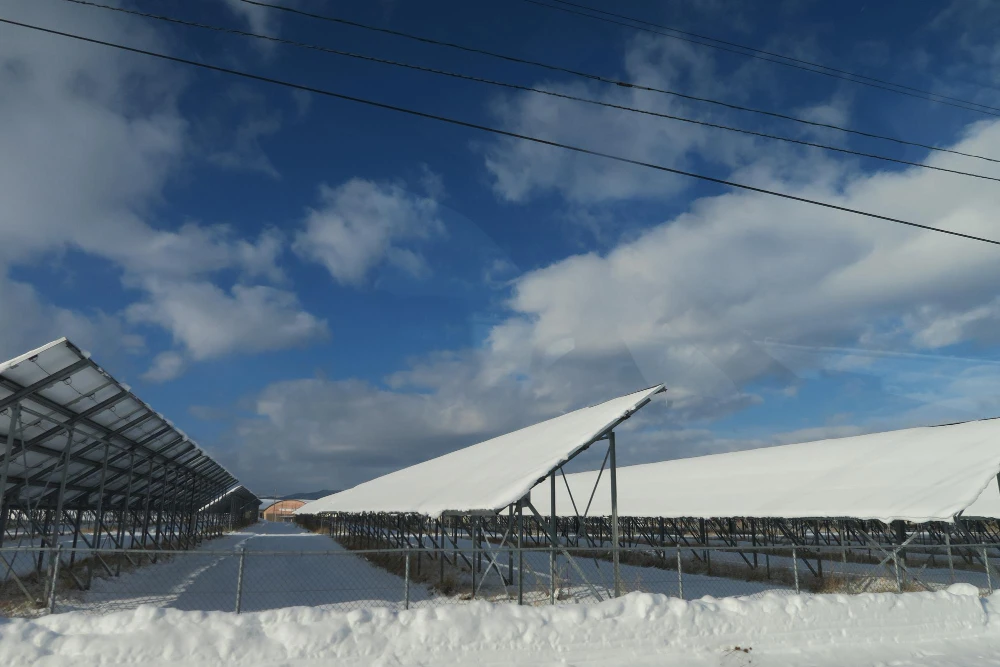
The primary concern is not freezing weather itself but dense snow cover that completely blocks sunlight from reaching photovoltaic modules. Until accumulated snow slides away or is removed, electricity generation can decrease substantially.
Snow loads must be considered during structural design
Northern, central and eastern regions of Kazakhstan experience considerable snowfall. Selecting an appropriate panel tilt angle allows much of the snow to slide off naturally, reducing winter production losses.
Engineering calculations also include roof capacity, mounting systems and supporting structures. Snow loads differ considerably between climate zones, making location-specific structural analysis essential.
Available equipment can be explored through the company's current listings.
Wind loads affect both safety and performance
Large areas of Kazakhstan are exposed to strong seasonal winds. During system design, engineers calculate not only maximum wind speeds but also aerodynamic forces acting on panels and mounting structures.
Poorly designed mounting systems may experience excessive vibration, structural deformation and increased mechanical stress. On the other hand, moderate airflow naturally cools solar modules, reducing thermal losses and improving operating efficiency.
Climate factors and their impact on electricity generation
| Climate factor | Impact | Typical effect |
|---|---|---|
| High temperature | Lower photovoltaic efficiency | 10–18% power reduction |
| Dust accumulation | Reduced sunlight transmission | 2–30% production loss |
| Snow cover | Temporary shading of modules | Significant reduction in generation |
| Strong winds | Higher structural loads | Requires reinforced mounting systems |
| Cool weather | Improved module efficiency | Slight increase in performance |
Every project requires location-specific engineering analysis
Even neighboring facilities can produce different annual energy outputs due to roof orientation, shading, terrain, local weather conditions and environmental contamination. That is why Helio Solar evaluates each project individually instead of relying solely on regional averages.
Additional expert articles are available in the company's News & Offers section.
Well-designed systems turn climate challenges into long-term advantages
Kazakhstan possesses excellent solar resources that support reliable photovoltaic generation throughout the year. Although temperature fluctuations, dust, snow and wind influence system performance, professional engineering and proper maintenance significantly reduce these effects. Carefully designed solar power plants continue delivering stable electricity production for decades under Kazakhstan's diverse climate conditions.
For a deeper understanding of long-term module performance, read the previous article about solar panel degradation and ways to extend service life.
More renewable energy solutions are available on the Mytrade.kz marketplace.