'%3e%3cpath%20d='M12.0683%2015.2949H11.015C10.9053%2015.2949%2010.8164%2015.3838%2010.8164%2015.4935V25.7849C10.8164%2025.8946%2010.9053%2025.9835%2011.015%2025.9835H12.0683C12.1779%2025.9835%2012.2668%2025.8946%2012.2668%2025.7849V15.4935C12.2668%2015.3838%2012.1779%2015.2949%2012.0683%2015.2949Z'%20fill='%230048FF'/%3e%3cpath%20d='M15.0278%2015.2949H13.9915C13.8819%2015.2949%2013.793%2015.3838%2013.793%2015.4935V25.7849C13.793%2025.8946%2013.8818%2025.9835%2013.9915%2025.9835H15.0278C15.1374%2025.9835%2015.2263%2025.8946%2015.2263%2025.7849V15.4935C15.2263%2015.3838%2015.1374%2015.2949%2015.0278%2015.2949Z'%20fill='%230048FF'/%3e%3cpath%20d='M9.09443%2015.2949H1.71809C1.60845%2015.2949%201.51953%2015.3838%201.51953%2015.4935V21.6128C1.51953%2024.0267%203.47634%2025.9834%205.89013%2025.9834H9.09448C9.20412%2025.9834%209.29304%2025.8946%209.29304%2025.7849V15.4935C9.29299%2015.3838%209.20407%2015.2949%209.09443%2015.2949Z'%20fill='%230048FF'/%3e%3cpath%20d='M24.342%2015.2949H16.9486C16.8389%2015.2949%2016.75%2015.3838%2016.75%2015.4935V25.7849C16.75%2025.8946%2016.8389%2025.9835%2016.9486%2025.9835H20.17C22.5838%2025.9835%2024.5406%2024.0267%2024.5406%2021.6129V15.4935C24.5406%2015.3838%2024.4517%2015.2949%2024.342%2015.2949Z'%20fill='%230048FF'/%3e%3cpath%20d='M15.016%206.07227H13.9798C13.8702%206.07227%2013.7812%206.16113%2013.7812%206.27082V13.6882C13.7812%2013.7978%2013.8701%2013.8868%2013.9798%2013.8868H15.016C15.1257%2013.8868%2015.2146%2013.7979%2015.2146%2013.6882V6.27077C15.2146%206.16113%2015.1257%206.07227%2015.016%206.07227Z'%20fill='%230048FF'/%3e%3cpath%20d='M12.0605%206.07227H11.0071C10.8975%206.07227%2010.8086%206.16113%2010.8086%206.27082V13.6882C10.8086%2013.7978%2010.8975%2013.8868%2011.0071%2013.8868H12.0605C12.1701%2013.8868%2012.259%2013.7979%2012.259%2013.6882V6.27077C12.259%206.16113%2012.1701%206.07227%2012.0605%206.07227Z'%20fill='%230048FF'/%3e%3cpath%20d='M23.5711%206.07227H16.9368C16.8272%206.07227%2016.7383%206.16113%2016.7383%206.27082V13.6882C16.7383%2013.7978%2016.8271%2013.8868%2016.9368%2013.8868H23.571C24.9125%2013.8868%2025.9999%2012.7993%2025.9999%2011.4578V8.50119C26%207.1597%2024.9125%206.07227%2023.5711%206.07227Z'%20fill='%230048FF'/%3e%3cpath%20d='M9.08494%206.07227H2.42892C1.08748%206.07221%200%207.15965%200%208.50114V11.4577C0%2012.7992%201.08748%2013.8867%202.42892%2013.8867H9.08494V13.8867C9.19457%2013.8867%209.28349%2013.7978%209.28349%2013.6881V6.27077C9.28349%206.16113%209.19457%206.07227%209.08494%206.07227Z'%20fill='%230048FF'/%3e%3cpath%20d='M20.1871%201.47349C18.9897%20-0.129579%2016.7113%20-0.459759%2015.1081%200.737715C14.8681%200.916974%2014.1377%201.46252%2013.1094%204.1681C13.109%204.16937%2013.1084%204.17064%2013.1079%204.17191C13.0397%204.35157%2013.173%204.54383%2013.3652%204.54383H20.6349C20.7291%204.54383%2020.8107%204.47766%2020.8298%204.38539C21.0343%203.40226%2020.8339%202.33941%2020.1871%201.47349Z'%20fill='%230048FF'/%3e%3cpath%20d='M12.4378%202.93607C11.6806%201.28298%2011.1489%200.885569%2010.9508%200.737694C9.34772%20-0.459731%207.06926%20-0.129601%205.87183%201.47346C5.22508%202.33944%205.02465%203.40224%205.22915%204.38542C5.24834%204.47764%205.32979%204.54386%205.42404%204.54386H11.7223C11.8052%204.54386%2011.8796%204.49231%2011.9084%204.41447C11.9384%204.33311%2011.9691%204.2509%2012.0006%204.16808C12.1533%203.76609%2012.2995%203.41209%2012.4385%203.09953C12.4616%203.04748%2012.4615%202.98792%2012.4378%202.93607Z'%20fill='%230048FF'/%3e%3c/g%3e%3cdefs%3e%3cclipPath%20id='clip0_4773_3494'%3e%3crect%20width='26'%20height='26'%20fill='white'/%3e%3c/clipPath%3e%3c/defs%3e%3c/svg%3e)
Free ad placement
EN


Free ad placement

Goods, services, cars, real estate and jobs

Create a seller page

EN



0

13

0




ТОО "Helio Solar"
Helio Solar is a company in the field of solar energy and renewable energy, which is engaged in the supply, design, installation and maintenance of solar power plants for businesses, private facilities and industrial enterprises in Kazakhstan.
A solar panel may look like a simple flat module on a roof or ground frame, but its real performance depends on more than sunlight alone. For a homeowner, warehouse owner, office, retail site or industrial facility, the practical question is not only how a panel creates electricity, but why panels with similar rated power can produce different results on different sites. This article explains the process in plain language, shows which technical figures matter, and helps understand why a solar power plant must be designed as a complete system. Helio Solar works in Kazakhstan with the supply, design, installation and servicing of solar power plants, and basic company information is available through the Helio Solar company profile on Mytrade.kz.
From sunlight to electric current
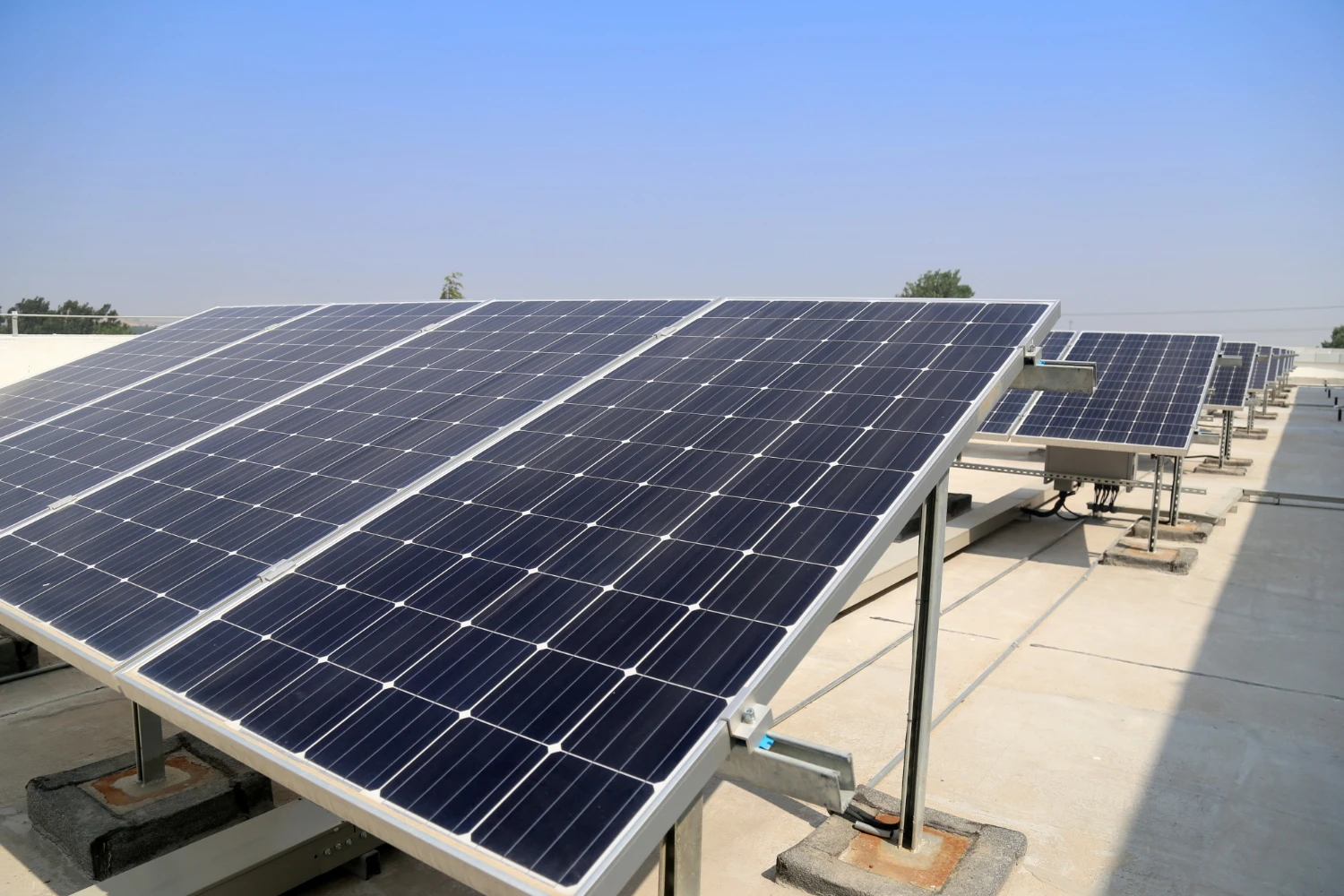
The operating principle of a solar panel is based on the photovoltaic effect. Inside the module there are semiconductor cells, most often made from silicon. When sunlight reaches these cells, light particles transfer energy to the material. This energy causes electrons to move, and that movement becomes direct current. One cell produces only a small amount of voltage, so many cells are connected into one module, and several modules are then connected into strings.
| Stage | What happens inside the system | Why it matters for the customer |
|---|---|---|
| 1. Sunlight reaches the module | Photons transfer energy to silicon cells | Panel orientation, tilt angle and shading become critical |
| 2. Direct current is generated | Electrons move through the electric circuit | Cell quality affects stable energy production |
| 3. Current goes to the inverter | The inverter converts direct current into alternating current | Most home and business equipment needs alternating current |
| 4. Electricity is distributed | Energy is used on-site, sent to the grid or stored in batteries | Grid-tied, off-grid and hybrid systems require different calculations |
For the site owner, the most important result is not the physical process inside the cell, but the actual energy output in kWh per day, month and season. That is why a solar project should not be evaluated only by the rated power of the panels. Visual examples of equipment and solution formats can be reviewed through the Helio Solar Reels videos.
Why rated power is not the same as real output
A panel may be marked as 450 W, 550 W or 600 W. This does not mean that it will deliver exactly that power every minute. Rated power is usually measured under standard test conditions: irradiance of 1000 W/m², cell temperature of 25 °C and a defined light spectrum. On a real roof or ground-mounted site, sunlight changes during the day, panels heat up, winter days are shorter, and dust, snow, shadow, cables and the inverter create additional losses.
| Technical figure | Typical reference point | Decision-making value |
|---|---|---|
| Rated module power | Many current commercial modules are commonly found in the 400–600 W range | Helps avoid treating peak laboratory power as constant site output |
| Standard test conditions | 1000 W/m² and 25 °C cell temperature | Shows that the passport figure is measured in controlled conditions |
| Module efficiency | Modern silicon modules are often around 20–23% | Prevents comparing panels only by percentage without considering area |
| Temperature coefficient | Often around minus 0.3–0.45% power per degree above 25 °C | Helps account for summer losses on hot roofs |
| Long-term degradation | NREL’s analytical review reports a median value of about 0.5% per year | Helps include gradual output reduction in long-term calculations |
| System losses | Inverter, cables, dust, shading and connection layout all affect the result | Prevents calculating a plant only by adding panel nameplate ratings |
This is why a solar power plant calculation should begin with the consumption profile, daytime load, available roof or land area, connection point, shading risks and expected operating mode. Helio Solar works with solar equipment supply, design, installation and servicing, while available directions can be reviewed through the seller offers for solar energy solutions.
How shade, heat and angle change the result
Solar panel output depends not only on the brightness of the sun. Tilt angle, orientation, module temperature, glass cleanliness and shading from parapets, pipes, trees, nearby buildings or antennas can all reduce energy production. Even a small shaded zone can have a larger effect than expected, especially when several panels are connected in one string and the weakest section limits the current of the whole group.
| Factor | Possible effect | What should be checked before installation |
|---|---|---|
| Shade from nearby objects | Current may drop in part of a module or in the whole string | Shade pattern in the morning, midday, evening and across seasons |
| Panel overheating | Output falls as cell temperature rises | Ventilation gap, roof material and module layout |
| Incorrect tilt angle | Part of the available sunlight is not used effectively | Roof geometry, orientation and usable area |
| Dust, leaves or snow | The glass surface passes less sunlight to the cells | Access for inspection and cleaning |
| Long cable routes | Electrical losses increase | Cable cross-section, route length and inverter location |
For business facilities, these details are especially important. If a site consumes a significant share of electricity during daylight hours, a correctly calculated solar plant can cover part of that daytime load. But if shade, overheating or connection layout are ignored, actual generation may be below expectations. Related company materials can be reviewed in the Helio Solar news and offers section.
A panel is only one part of the power plant
A solar panel alone is not a complete power plant. It produces direct current, but a house, office, warehouse or industrial site needs a full system: inverter, mounting structure, cable lines, protective devices, metering cabinets, monitoring and, when required, batteries. A mistake in one component can reduce the performance of the whole system, even if the panels themselves are technically suitable.
| PV system element | Role in the system | What should be checked |
|---|---|---|
| Solar panels | Capture sunlight and generate direct current | Power, cell type, size, compatibility and degradation profile |
| Inverter | Converts direct current into alternating current | Power rating, voltage range, number of inputs and protection functions |
| Mounting structure | Holds panels at the calculated angle | Roof type, wind load and corrosion resistance |
| Cable lines | Transfer energy from modules to equipment | Cross-section, route length and mechanical protection |
| Monitoring | Shows actual output and deviations | Data access, generation history and alert functions |
The global market shows that photovoltaic systems are already a mass-scale technology: IEA PVPS reports that global cumulative PV capacity exceeded 2.2 TW in 2024, with at least 554 GW of new PV systems commissioned during that year. Short video materials from different companies and solution categories can also be viewed in the Mytrade.kz short video section.
Questions to ask before choosing solar panels
A common buyer mistake is comparing panels only by the price per unit or the highest rated wattage. A more practical approach is to estimate useful energy for the specific site. For a private home, the consumption profile and available roof area are important. For a business, the daytime load, operating schedule, equipment profile, connection point, backup needs and future expansion plans may be decisive.
| Question before purchase | Why it matters | What a responsible answer should include |
|---|---|---|
| How much electricity does the site consume during the day? | Solar generation is strongest during daylight hours | A calculation based on daytime load, not only on the monthly bill |
| Is there shade on the roof or ground area? | Shade can reduce one module, one string or the whole plant output | Seasonal and time-of-day shading assessment |
| Which system type fits the task? | Grid-tied, off-grid and hybrid plants solve different problems | Clear justification based on load and operating mode |
| How will the plant be monitored? | Dust, connectors, mounting points and generation data need control | A practical inspection and monitoring procedure |
| What monthly generation is expected? | Summer and winter output are not the same | Monthly forecast, not only one annual figure |
Helio Solar works with solar power plants for private facilities, commercial buildings and industrial enterprises. Before a calculation, the goal should be defined clearly: reducing daytime grid consumption, building an autonomous system, adding backup capability or choosing a hybrid layout. To compare suppliers and review marketplace listings, users can also navigate through the Mytrade.kz marketplace.
Clear technical logic helps avoid a wrong choice
A solar panel turns light into electricity, but the final benefit depends on more than the module itself. The inverter, mounting system, cable routes, protection devices, tilt angle, shade, temperature, servicing and monitoring should be considered together. When a customer understands these basic principles before purchase, it becomes easier to ask the contractor precise questions and avoid paying for capacity that will not deliver the expected output on the real site.
Before ordering a solar power plant, it is also useful to understand the mistakes that often occur at the equipment selection and installation stage. This topic is continued in the previous guide on common mistakes when choosing and installing a solar power plant.