'%3e%3cpath%20d='M12.0683%2015.2949H11.015C10.9053%2015.2949%2010.8164%2015.3838%2010.8164%2015.4935V25.7849C10.8164%2025.8946%2010.9053%2025.9835%2011.015%2025.9835H12.0683C12.1779%2025.9835%2012.2668%2025.8946%2012.2668%2025.7849V15.4935C12.2668%2015.3838%2012.1779%2015.2949%2012.0683%2015.2949Z'%20fill='%230048FF'/%3e%3cpath%20d='M15.0278%2015.2949H13.9915C13.8819%2015.2949%2013.793%2015.3838%2013.793%2015.4935V25.7849C13.793%2025.8946%2013.8818%2025.9835%2013.9915%2025.9835H15.0278C15.1374%2025.9835%2015.2263%2025.8946%2015.2263%2025.7849V15.4935C15.2263%2015.3838%2015.1374%2015.2949%2015.0278%2015.2949Z'%20fill='%230048FF'/%3e%3cpath%20d='M9.09443%2015.2949H1.71809C1.60845%2015.2949%201.51953%2015.3838%201.51953%2015.4935V21.6128C1.51953%2024.0267%203.47634%2025.9834%205.89013%2025.9834H9.09448C9.20412%2025.9834%209.29304%2025.8946%209.29304%2025.7849V15.4935C9.29299%2015.3838%209.20407%2015.2949%209.09443%2015.2949Z'%20fill='%230048FF'/%3e%3cpath%20d='M24.342%2015.2949H16.9486C16.8389%2015.2949%2016.75%2015.3838%2016.75%2015.4935V25.7849C16.75%2025.8946%2016.8389%2025.9835%2016.9486%2025.9835H20.17C22.5838%2025.9835%2024.5406%2024.0267%2024.5406%2021.6129V15.4935C24.5406%2015.3838%2024.4517%2015.2949%2024.342%2015.2949Z'%20fill='%230048FF'/%3e%3cpath%20d='M15.016%206.07227H13.9798C13.8702%206.07227%2013.7812%206.16113%2013.7812%206.27082V13.6882C13.7812%2013.7978%2013.8701%2013.8868%2013.9798%2013.8868H15.016C15.1257%2013.8868%2015.2146%2013.7979%2015.2146%2013.6882V6.27077C15.2146%206.16113%2015.1257%206.07227%2015.016%206.07227Z'%20fill='%230048FF'/%3e%3cpath%20d='M12.0605%206.07227H11.0071C10.8975%206.07227%2010.8086%206.16113%2010.8086%206.27082V13.6882C10.8086%2013.7978%2010.8975%2013.8868%2011.0071%2013.8868H12.0605C12.1701%2013.8868%2012.259%2013.7979%2012.259%2013.6882V6.27077C12.259%206.16113%2012.1701%206.07227%2012.0605%206.07227Z'%20fill='%230048FF'/%3e%3cpath%20d='M23.5711%206.07227H16.9368C16.8272%206.07227%2016.7383%206.16113%2016.7383%206.27082V13.6882C16.7383%2013.7978%2016.8271%2013.8868%2016.9368%2013.8868H23.571C24.9125%2013.8868%2025.9999%2012.7993%2025.9999%2011.4578V8.50119C26%207.1597%2024.9125%206.07227%2023.5711%206.07227Z'%20fill='%230048FF'/%3e%3cpath%20d='M9.08494%206.07227H2.42892C1.08748%206.07221%200%207.15965%200%208.50114V11.4577C0%2012.7992%201.08748%2013.8867%202.42892%2013.8867H9.08494V13.8867C9.19457%2013.8867%209.28349%2013.7978%209.28349%2013.6881V6.27077C9.28349%206.16113%209.19457%206.07227%209.08494%206.07227Z'%20fill='%230048FF'/%3e%3cpath%20d='M20.1871%201.47349C18.9897%20-0.129579%2016.7113%20-0.459759%2015.1081%200.737715C14.8681%200.916974%2014.1377%201.46252%2013.1094%204.1681C13.109%204.16937%2013.1084%204.17064%2013.1079%204.17191C13.0397%204.35157%2013.173%204.54383%2013.3652%204.54383H20.6349C20.7291%204.54383%2020.8107%204.47766%2020.8298%204.38539C21.0343%203.40226%2020.8339%202.33941%2020.1871%201.47349Z'%20fill='%230048FF'/%3e%3cpath%20d='M12.4378%202.93607C11.6806%201.28298%2011.1489%200.885569%2010.9508%200.737694C9.34772%20-0.459731%207.06926%20-0.129601%205.87183%201.47346C5.22508%202.33944%205.02465%203.40224%205.22915%204.38542C5.24834%204.47764%205.32979%204.54386%205.42404%204.54386H11.7223C11.8052%204.54386%2011.8796%204.49231%2011.9084%204.41447C11.9384%204.33311%2011.9691%204.2509%2012.0006%204.16808C12.1533%203.76609%2012.2995%203.41209%2012.4385%203.09953C12.4616%203.04748%2012.4615%202.98792%2012.4378%202.93607Z'%20fill='%230048FF'/%3e%3c/g%3e%3cdefs%3e%3cclipPath%20id='clip0_4773_3494'%3e%3crect%20width='26'%20height='26'%20fill='white'/%3e%3c/clipPath%3e%3c/defs%3e%3c/svg%3e)
Free ad placement
EN


Free ad placement

Goods, services, cars, real estate and jobs

Create a seller page

EN



0

13

0




ТОО "Helio Solar"
Helio Solar is a company in the field of solar energy and renewable energy, which is engaged in the supply, design, installation and maintenance of solar power plants for businesses, private facilities and industrial enterprises in Kazakhstan.
Preparing a site for a solar power plant starts before choosing panels, inverter capacity or mounting systems. The same equipment set can perform differently on two similar buildings because roof orientation, shading, cable routes, electrical input, available area and daytime consumption patterns all affect the final result. This guide is useful for homeowners, warehouses, offices, farms and industrial facilities that want to understand what must be checked before installation work begins.
Why the site must be assessed before equipment selection
Kazakhstan has strong conditions for solar energy: many industry references indicate about 2,200–3,000 sunshine hours per year in different regions, while annual solar irradiation is often estimated at roughly 1,300–1,800 kWh/m². Still, these figures do not mean that every roof or land plot will generate the same output. Real performance depends on how well the site is prepared and how accurately its limitations are identified.
TOO "Helio Solar" works in the field of supply, design, installation and maintenance of solar power plants for private, commercial and industrial facilities. Before requesting a technical calculation, a customer can review the Helio Solar company profile on Mytrade.kz and prepare basic site information.
| Site parameter | Why it matters | What to prepare |
|---|---|---|
| Available roof or land area | Defines how many modules can be installed without blocking service zones | Measurements, plan, photos, obstacles and access paths |
| Orientation and tilt | Affects the daily generation curve and expected production | Roof direction, slope angle, south-facing areas |
| Shading | Even partial shading can reduce the output of a module group | Morning, midday and evening photos, nearby trees and buildings |
| Roof condition | Shows whether the structure can accept mounting without prior repair | Roof material, leaks, visible wear, access to structural elements |
| Electrical input | Influences inverter location, protection devices and connection scheme | Photos of the switchboard, breakers, available space and input data |
Roof, ground or canopy: preparation is not the same
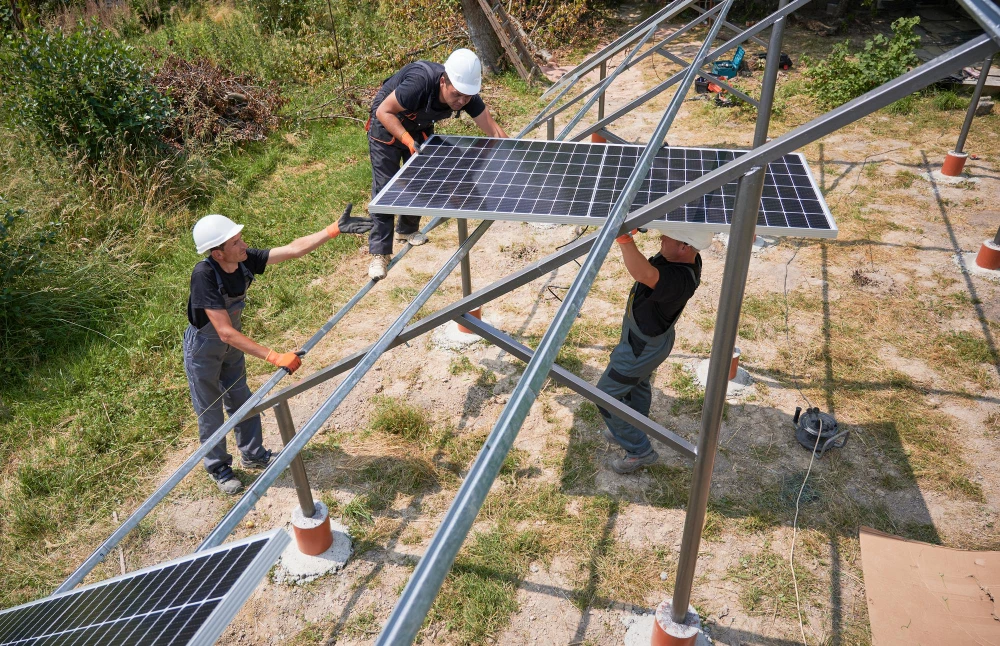
A pitched roof requires attention to covering material, slope, rafters or load-bearing zones, safe access and fastening points. A flat roof requires additional checks for wind load, parapets, waterproofing, drainage and maintenance walkways. A ground-mounted plant requires a review of soil, terrain, drainage, fencing, vehicle access and distance to the electrical connection point.
A modern solar module usually occupies about 2–2.6 m². For 1 kW of installed capacity, a preliminary estimate often requires around 4–6 m² of useful surface, excluding complex roof geometry, service passages and additional offsets. This means that a large roof is not always fully usable: vents, chimneys, air-conditioning units, antennas and safety zones can reduce the effective area.
When comparing system configurations, the customer should look beyond panel wattage. Inverters, cables, mounting systems, protection devices, monitoring and future maintenance also matter. Current options can be viewed through seller offers for solar power plants.
| Installation area | Main risk | What to check before a site visit |
|---|---|---|
| Pitched roof | Weak covering, difficult access, unsuitable fastening points | Roof material, slope, visible defects, access to structural zones |
| Flat roof | Wind pressure, waterproofing damage, limited service walkways | Parapets, drainage points, permitted load and technical zones |
| Ground area | Soil settlement, flooding risk, long cable routes | Terrain, drainage, distance to the switchboard and vehicle access |
| Canopy or metal frame | Insufficient rigidity and wind resistance | Frame dimensions, fastening nodes, tilt and maintenance access |
Shading must be checked at different times of day
Shading is one of the most underestimated issues in solar site preparation. A pipe, tree, neighboring building or advertising structure may cover only a small part of the array, but it can still change the placement scheme. Seasonal movement also matters: in winter, the sun is lower and shadows become longer, so one summer photo is not enough for reliable assessment.
Before technical inspection, it is useful to make short videos and photos of the site: the full roof view, obstacles, electrical board, possible inverter location and future cable route. A visual format makes the task clearer for engineers; examples can be viewed in the Helio Solar Reels section.
| Factor | Impact on solar plant operation | What the customer can do |
|---|---|---|
| Tree shading | May cover modules in the morning or evening | Take photos at several times of the day |
| Chimneys, antennas and vents | Reduce usable area and create bypass zones | Mark all obstacles on the roof plan |
| Neighboring buildings | Can create seasonal shadows, especially in winter | Estimate height, distance and shadow direction |
| Dust and dirt | May lower actual module output over time | Leave safe access for periodic cleaning |
| Overheating | High temperature reduces real module performance | Keep ventilation gaps and avoid blocking airflow |
The electrical system determines how the plant will be connected
A solar power plant is not only a set of panels on the roof. The inverter, protection equipment, cable routes and connection point must work with the existing electrical system of the facility. Before design work starts, it is important to know where the main switchboard is located, what capacity is available, how loads are distributed and whether there is a suitable technical area for the inverter.
For commercial facilities, the consumption profile is especially important. If the main load operates during the day, solar generation may match the facility’s working pattern better. If consumption moves to evening or night hours, the calculation logic changes. TOO "Helio Solar" treats a solar plant as an engineering system where equipment, installation and maintenance must correspond to the real site conditions.
| Electrical data | Why it is needed | Convenient format |
|---|---|---|
| Photos of the main switchboard | To assess connection points, breakers and available space | General view and close-up photos |
| Available input capacity | To understand facility limitations and possible connection scheme | Contractual or technical data for the site |
| Monthly electricity use | To size the plant closer to real demand | Bills, meter readings or monthly consumption reports |
| Inverter location | To reduce cable length and keep equipment serviceable | Dry, ventilated and accessible technical area |
| Cable route | To estimate route length and wall or roof penetration points | Possible path from panels to inverter and switchboard |
Additional materials about solar energy, equipment selection and preparation for installation can be followed in the Helio Solar news and offers section.
Typical preparation mistakes that should be removed early
A common mistake is to treat the whole roof as usable. In reality, part of the surface may be occupied by ventilation shafts, chimneys, drainage zones, air-conditioning units, safety areas and technical walkways. Another risk is ignoring roof wear. If the covering has leaks or visible defects, solar installation should be planned after the roof problem is addressed, not before.
Missing consumption data is also a serious limitation. Without it, the plant capacity is estimated too roughly, while commercial customers often depend on daytime peaks, seasonal production, equipment schedules and possible future load growth. TOO "Helio Solar" can be useful when the customer already understands the site parameters and wants to move from a general idea to a technically reasoned solution.
To compare different equipment-related formats, supplier pages and short videos, customers can also use the short video section on Mytrade.kz.
| Preparation mistake | Possible consequence | How to reduce the risk |
|---|---|---|
| No shading check | The panel layout may need to be changed after inspection | Take photos and videos in the morning, at midday and in the evening |
| Roof condition is unknown | Additional work may appear before installation | Inspect covering, waterproofing and load-bearing elements |
| No inverter place selected | Cable routes become longer and service access worsens | Choose a technical zone close to the electrical system |
| No consumption data collected | Plant capacity is calculated less accurately | Prepare several months of bills or meter readings |
| No maintenance path planned | Panels can block service access or drainage areas | Mark walkways and service zones on the roof or site plan |
Minimum data package before contacting specialists
The customer does not need to calculate the full system independently. However, without basic site data, an engineer cannot evaluate the object accurately. The more complete the information, the lower the risk that the project will need to be revised after a site visit or during installation work.
| Data to prepare | Who needs it most | Practical format |
|---|---|---|
| Address and facility type | Homes, warehouses, offices, farms and production sites | City, building purpose and access to roof or land plot |
| Site photos | All facilities | Roof, land area, facade, switchboard and inverter location |
| Usable area measurements | Complex roofs and ground-mounted systems | Length, width, obstacles, walkways and restricted zones |
| Electricity consumption | Businesses and homes with high load | Monthly bills, meter readings and daytime load information |
| Site restrictions | Old buildings, rented areas and industrial facilities | No-drilling zones, weak roof areas and limited access points |
Supplier showcases, offers and company pages can be compared through the Mytrade.kz marketplace.
When the site is ready for solar plant calculation
A site is ready for a technical solar plant calculation when the installation location, usable area, roof or ground condition, connection point, consumption pattern and main restrictions are clear. At this stage, equipment selection becomes more precise: the discussion is no longer about an abstract capacity, but about a system that fits real site conditions.
If the panel type has not yet been selected, site preparation should be connected with module technology. At this point, the material on differences between monocrystalline and polycrystalline solar panels may be useful. This approach helps evaluate a solar power plant not only by equipment cost, but also by whether the facility is truly ready for installation.