A furnished room may look ideal in photographs and still become uncomfortable after the first week. Daily life is shaped by factors that listings often show poorly: bathroom queues, noise after midnight, kitchen capacity, ventilation, house rules and the time required to reach work or university. This guide is intended for people comparing shared accommodation in Almaty and trying to assess the complete living arrangement rather than the bedroom alone. Suitable options can first be reviewed through the Mytrade.kz marketplace and then checked against a practical comfort audit.
Comfort is a system, not a feature of one room
Kazakhstan’s Bureau of National Statistics reported that the national housing stock reached 447.3 million square metres in 2025. Average housing availability increased to 25.1 m² per person, while Almaty accounted for approximately 58.3 million m² of housing stock. These figures describe the scale of the market, but they cannot show whether six residents share one bathroom, whether the kitchen is crowded every evening or whether the apartment remains quiet at night.
This is why two rooms with similar floor areas may deliver completely different living experiences. Before arranging a viewing, a prospective tenant can examine the SOFA.bz company profile on Mytrade.kz. According to the information supplied about the service, SOFA.bz offers furnished rooms and places in larger Almaty apartments, with organised cleaning, defined living rules and occupancy under an agreement.
Seven areas to assess before making a decision
- The number of permanent residents and their daily schedules.
- The capacity of bathrooms, the kitchen and storage areas.
- Noise from traffic, lifts, entrances and neighbouring rooms.
- Heating, ventilation, daylight and signs of dampness.
- Rules covering guests, smoking, cleaning and quiet hours.
- Travel time during the hours when the journey will actually be made.
- The full monthly cost, including utilities and shared household purchases.
Shared facilities create the first daily bottleneck
A bathroom technically exists whether it serves two residents or seven, but the practical result is not the same. If a tenant waits 12 minutes every weekday morning, the accumulated delay reaches 4 hours and 24 minutes over 22 working days. A similar calculation applies to the washing machine, cooking space and refrigerator shelves.
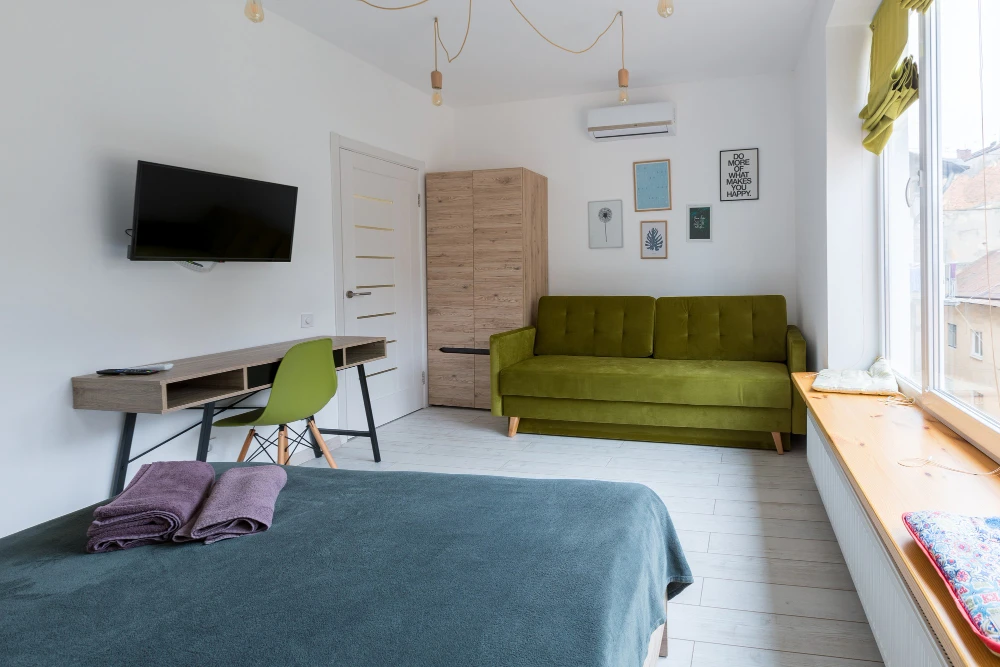
During a viewing, count usable cupboards, food-storage zones, electrical sockets and places for drying clothes. Turn on the shower and kitchen tap at the same time to check pressure. Ask when most residents prepare meals and whether cleaning duties are assigned or simply expected. Photographs of available accommodation should be compared through the current room listings from SOFA.bz, with attention given to common areas rather than only the bed and wardrobe.
Privacy depends on occupancy and household behaviour
Privacy in shared housing does not mean complete isolation. It means being able to sleep, work, make a phone call and store personal belongings without constant interruption. Ask whether bedroom doors can be locked, how food is separated and whether guests may stay overnight. It is also useful to establish whether any living room or passage area is used as an additional sleeping place.
Room size should therefore be considered together with occupancy density. Ten square metres may feel adequate in a well-managed apartment with predictable routines, while a larger room may feel restrictive when corridors, bathrooms and the kitchen are permanently congested. Video can reveal circulation routes and shared-space proportions more clearly than isolated photographs, so the SOFA.bz Reels collection can support preliminary comparison before an in-person inspection.
Night-time noise should be tested, not assumed
The World Health Organization describes noise as “an underestimated threat”. Its community-noise guidance recommends less than 30 dB(A) inside bedrooms at night for good-quality sleep. Excessive environmental noise is associated with sleep disturbance, reduced performance, hypertension and other health effects.
A daytime viewing may conceal the most important problem. Visit after 20:00 when possible, close the window and listen for traffic, lifts, entrance doors, plumbing and conversations from adjacent rooms. Then open the window to understand whether ventilation requires accepting continuous street noise. A phone application cannot replace professional measurement, but it can help compare two properties under similar conditions.
Temperature and air quality matter after the photographs stop impressing
National statistics show that in 2025, 98% of Kazakhstan’s housing stock had water supply, 79% had sewerage, 46% had central heating and 39% had central hot-water supply. These national indicators do not confirm performance inside a particular apartment. Water pressure, radiator output, draughts and hot-water stability must still be tested during the viewing.
WHO housing guidance describes 18°C as a “safe and well-balanced indoor temperature” for the general population during cold seasons in temperate or colder climates. Prospective tenants should also inspect window frames, exterior corners and the area behind furniture for condensation, peeling finishes or a persistent damp smell. Where possible, ask how warm the room was during the previous winter rather than accepting a general statement that the building is heated.
Daylight is another practical consideration, particularly for people who study or work from home. A workplace study found that participants with windows slept an average of 46 minutes longer per night than those without windows. The researchers stated that their results “underscore the importance of daytime light exposures for sleep health”. This does not prove that every bright bedroom improves sleep by the same amount, but it supports checking orientation, window size and daylight before signing.
House rules are part of the rental conditions
Many shared-living conflicts begin with expectations that were never discussed. One resident assumes that guests are acceptable at any time, while another expects silence after 22:00. Someone may regard weekly cleaning as sufficient, while another expects the kitchen to be cleaned immediately after every use.
Before moving in, clarify quiet hours, smoking restrictions, guest arrangements, cleaning responsibilities, shared purchases and the procedure for reporting damage. SOFA.bz states that its accommodation format includes clear living rules and occupancy under an agreement. Related guidance and service updates can be reviewed in the SOFA.bz news and offers section.
Questions that reveal how the household operates
- How many people are normally at home in the morning and evening?
- Who buys cleaning products and other shared supplies?
- What happens when a resident repeatedly ignores the rules?
- How are faults in shared appliances reported?
- Which payments are included and which are divided separately?
Location should be calculated in hours, not kilometres
A lower monthly payment may lose its advantage when the property adds a long commute. An extra 25 minutes in each direction equals 18 hours and 20 minutes over 22 working days. It may also increase spending on taxis when public transport becomes less frequent in the evening.
Test the route at the time it will normally be used. Check the walk to the stop, street lighting, transfers, nearby shops and access to a pharmacy. The short-video section on Mytrade.kz can help users compare neighbourhoods and accommodation formats, but the final route should be travelled personally before committing.
A comfortable room is one that supports the whole routine
The strongest option is not necessarily the room with the newest furniture or the largest floor area. It is the accommodation where sleep, hygiene, cooking, privacy, transport and household rules work together without creating repeated friction. SOFA.bz options should be assessed using the same disciplined approach: view the shared spaces, speak about routines, test essential facilities and ensure that important conditions are recorded in the agreement.
Comfort should also be considered together with the complete financial burden. For a structured method of comparing rent, utilities, transport and additional expenses, read the previous guide on how to calculate the real cost of renting a room.