'%3e%3cpath%20d='M12.0683%2015.2949H11.015C10.9053%2015.2949%2010.8164%2015.3838%2010.8164%2015.4935V25.7849C10.8164%2025.8946%2010.9053%2025.9835%2011.015%2025.9835H12.0683C12.1779%2025.9835%2012.2668%2025.8946%2012.2668%2025.7849V15.4935C12.2668%2015.3838%2012.1779%2015.2949%2012.0683%2015.2949Z'%20fill='%230048FF'/%3e%3cpath%20d='M15.0278%2015.2949H13.9915C13.8819%2015.2949%2013.793%2015.3838%2013.793%2015.4935V25.7849C13.793%2025.8946%2013.8818%2025.9835%2013.9915%2025.9835H15.0278C15.1374%2025.9835%2015.2263%2025.8946%2015.2263%2025.7849V15.4935C15.2263%2015.3838%2015.1374%2015.2949%2015.0278%2015.2949Z'%20fill='%230048FF'/%3e%3cpath%20d='M9.09443%2015.2949H1.71809C1.60845%2015.2949%201.51953%2015.3838%201.51953%2015.4935V21.6128C1.51953%2024.0267%203.47634%2025.9834%205.89013%2025.9834H9.09448C9.20412%2025.9834%209.29304%2025.8946%209.29304%2025.7849V15.4935C9.29299%2015.3838%209.20407%2015.2949%209.09443%2015.2949Z'%20fill='%230048FF'/%3e%3cpath%20d='M24.342%2015.2949H16.9486C16.8389%2015.2949%2016.75%2015.3838%2016.75%2015.4935V25.7849C16.75%2025.8946%2016.8389%2025.9835%2016.9486%2025.9835H20.17C22.5838%2025.9835%2024.5406%2024.0267%2024.5406%2021.6129V15.4935C24.5406%2015.3838%2024.4517%2015.2949%2024.342%2015.2949Z'%20fill='%230048FF'/%3e%3cpath%20d='M15.016%206.07227H13.9798C13.8702%206.07227%2013.7812%206.16113%2013.7812%206.27082V13.6882C13.7812%2013.7978%2013.8701%2013.8868%2013.9798%2013.8868H15.016C15.1257%2013.8868%2015.2146%2013.7979%2015.2146%2013.6882V6.27077C15.2146%206.16113%2015.1257%206.07227%2015.016%206.07227Z'%20fill='%230048FF'/%3e%3cpath%20d='M12.0605%206.07227H11.0071C10.8975%206.07227%2010.8086%206.16113%2010.8086%206.27082V13.6882C10.8086%2013.7978%2010.8975%2013.8868%2011.0071%2013.8868H12.0605C12.1701%2013.8868%2012.259%2013.7979%2012.259%2013.6882V6.27077C12.259%206.16113%2012.1701%206.07227%2012.0605%206.07227Z'%20fill='%230048FF'/%3e%3cpath%20d='M23.5711%206.07227H16.9368C16.8272%206.07227%2016.7383%206.16113%2016.7383%206.27082V13.6882C16.7383%2013.7978%2016.8271%2013.8868%2016.9368%2013.8868H23.571C24.9125%2013.8868%2025.9999%2012.7993%2025.9999%2011.4578V8.50119C26%207.1597%2024.9125%206.07227%2023.5711%206.07227Z'%20fill='%230048FF'/%3e%3cpath%20d='M9.08494%206.07227H2.42892C1.08748%206.07221%200%207.15965%200%208.50114V11.4577C0%2012.7992%201.08748%2013.8867%202.42892%2013.8867H9.08494V13.8867C9.19457%2013.8867%209.28349%2013.7978%209.28349%2013.6881V6.27077C9.28349%206.16113%209.19457%206.07227%209.08494%206.07227Z'%20fill='%230048FF'/%3e%3cpath%20d='M20.1871%201.47349C18.9897%20-0.129579%2016.7113%20-0.459759%2015.1081%200.737715C14.8681%200.916974%2014.1377%201.46252%2013.1094%204.1681C13.109%204.16937%2013.1084%204.17064%2013.1079%204.17191C13.0397%204.35157%2013.173%204.54383%2013.3652%204.54383H20.6349C20.7291%204.54383%2020.8107%204.47766%2020.8298%204.38539C21.0343%203.40226%2020.8339%202.33941%2020.1871%201.47349Z'%20fill='%230048FF'/%3e%3cpath%20d='M12.4378%202.93607C11.6806%201.28298%2011.1489%200.885569%2010.9508%200.737694C9.34772%20-0.459731%207.06926%20-0.129601%205.87183%201.47346C5.22508%202.33944%205.02465%203.40224%205.22915%204.38542C5.24834%204.47764%205.32979%204.54386%205.42404%204.54386H11.7223C11.8052%204.54386%2011.8796%204.49231%2011.9084%204.41447C11.9384%204.33311%2011.9691%204.2509%2012.0006%204.16808C12.1533%203.76609%2012.2995%203.41209%2012.4385%203.09953C12.4616%203.04748%2012.4615%202.98792%2012.4378%202.93607Z'%20fill='%230048FF'/%3e%3c/g%3e%3cdefs%3e%3cclipPath%20id='clip0_4773_3494'%3e%3crect%20width='26'%20height='26'%20fill='white'/%3e%3c/clipPath%3e%3c/defs%3e%3c/svg%3e)
Free ad placement
EN


Free ad placement

Goods, services, cars, real estate and jobs

Create a seller page

EN



0

12

0




ТОО "Helio Solar"
Helio Solar is a company in the field of solar energy and renewable energy, which is engaged in the supply, design, installation and maintenance of solar power plants for businesses, private facilities and industrial enterprises in Kazakhstan.
A successful solar power plant begins long before electricity is generated. Even carefully selected equipment may fail to deliver expected performance if installation is performed without proper engineering procedures. Every phase—from site preparation to electrical commissioning—directly influences safety, energy production, and operational stability. For homeowners, commercial facilities, and industrial enterprises, understanding the installation process helps evaluate contractors and reduce technical risks. Helio Solar provides solar equipment supply, engineering design, installation, and maintenance services in Kazakhstan, treating installation as a continuation of accurate project planning rather than a separate construction task.
Why Professional Installation Determines Long-Term Performance
International studies published by the International Energy Agency (IEA) indicate that installation quality significantly affects the lifetime energy output of photovoltaic systems. Incorrect panel orientation, inadequate ventilation, poor cable routing, or improperly configured electrical protection can reduce annual electricity generation and increase maintenance costs.
Installation therefore should always follow approved engineering documentation rather than being adjusted during construction. Every component of the system is designed to operate as part of one integrated solution.
Company information and core business activities are available on the Helio Solar company profile on Mytrade.kz.
Stage 1. Preparing the Installation Site
Before equipment arrives, specialists evaluate whether the site fully complies with engineering documentation. Roof structures, ground foundations, cable routes, equipment rooms, and access points are inspected to prevent delays during construction.
Typical preparation includes:
- verification of structural load capacity;
- assessment of potential shading throughout the year;
- inspection of roof or ground conditions;
- planning DC and AC cable routing;
- selection of inverter and protection equipment locations.
Thorough preparation minimizes unexpected modifications during later installation stages and helps maintain compliance with the original engineering concept.
Stage 2. Installing the Mounting Structures
The supporting framework forms the foundation of every photovoltaic installation. Since mounting systems must withstand wind loads, snow loads, and long-term environmental exposure, installation accuracy is essential.
Engineers verify alignment, spacing, fastening torque, and overall structural geometry before solar modules are installed.
Examples of completed installations can be seen in the company's Reels video gallery, demonstrating different solutions for residential, commercial, and industrial projects.
Stage 3. Installing Photovoltaic Modules
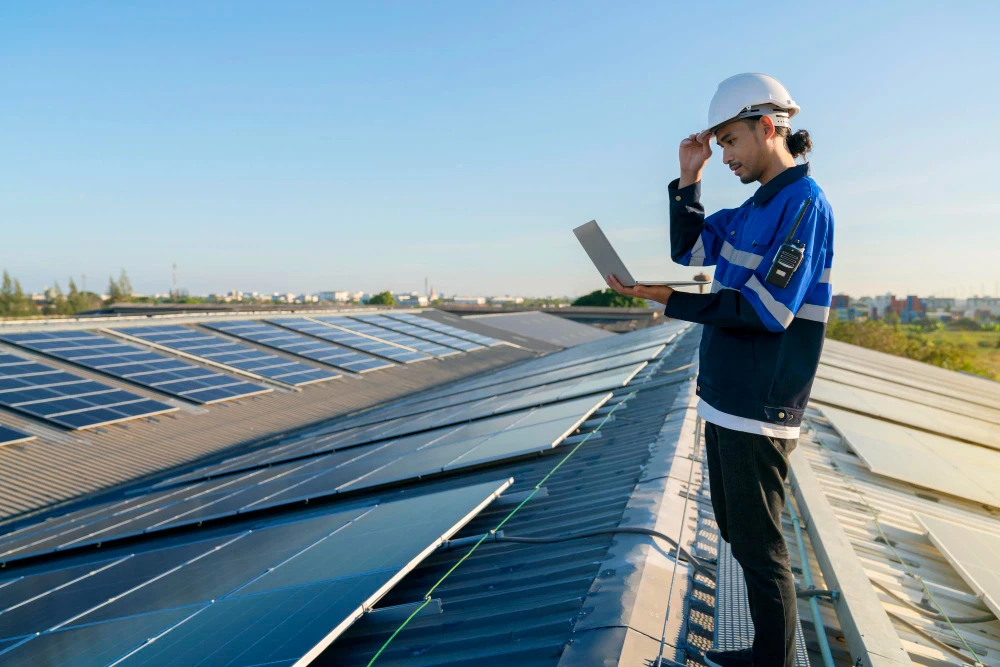
Solar panels are mounted according to the approved layout while maintaining specified tilt angles, spacing between rows, and manufacturer installation requirements. Proper positioning helps maximize annual solar irradiation and simplifies future maintenance.
During this phase specialists pay particular attention to:
- accurate module positioning;
- secure mechanical fastening;
- safe cable management;
- correct electrical string connections;
- visual inspection of every installed module.
Although installation methods vary depending on roof type or ground-mounted systems, engineering accuracy remains the primary objective.
Stage 4. Electrical Installation
Once mechanical work has been completed, electricians install inverters, protection devices, grounding systems, monitoring equipment, and connect DC and AC circuits. Every connection is checked according to electrical safety requirements before commissioning begins.
Available solar equipment and related solutions can be explored through the current offers published by the company.
Stage 5. Commissioning and System Testing
Mechanical installation alone does not mean a solar power plant is ready for operation. Before electricity generation begins, engineers perform comprehensive commissioning procedures to verify that every component functions as designed. Electrical measurements, insulation testing, inverter configuration, protection devices, and communication systems are checked before the system is energized.
Measured values are compared with the engineering calculations completed during the design phase. If any deviations are identified, adjustments are made before the plant enters normal operation. This process reduces operational risks and improves long-term reliability.
Modern monitoring platforms integrated into many inverter systems also allow owners to supervise electricity production remotely, detect abnormal operating conditions, and monitor system performance over time.
Stage 6. System Start-Up and Ongoing Operation
Once commissioning has been successfully completed, the solar power plant is placed into service. However, installation should be viewed as the beginning of the system's operational lifecycle rather than the final milestone. Regular inspections, performance monitoring, and scheduled maintenance help preserve energy production and extend equipment service life.
Helio Solar supports projects involving solar energy systems through engineering, installation, and maintenance services, allowing customers to maintain stable operation throughout the lifetime of the equipment.
Additional industry articles and practical information are regularly published in the company news and insights section.
Installation Errors That Can Reduce Energy Production
Many operational issues originate not from equipment quality but from installation mistakes. Among the most common problems are:
- incorrect module orientation;
- partial shading caused by nearby structures or vegetation;
- insufficient airflow beneath photovoltaic modules;
- improper DC string connections;
- poor grounding installation;
- incorrect tightening of mounting hardware;
- insufficient testing before system commissioning.
Correcting these problems after installation is often considerably more expensive than preventing them during construction.
Engineering Accuracy Creates Long-Term Value
Every installation stage contributes to the overall efficiency and reliability of a solar power plant. Proper site preparation, structural installation, electrical integration, commissioning, and ongoing monitoring work together as one engineering process. When each phase is completed according to design documentation, the system is better positioned to deliver predictable performance for many years.
To better understand how engineering calculations influence installation quality, readers may also review the previous article explaining solar power plant design, engineering calculations, and common planning mistakes.
Industry developments, renewable energy projects, and practical implementation examples can also be explored through the Mytrade.kz Reels collection. Additional suppliers and renewable energy solutions are available across the Mytrade.kz marketplace.