
This article is for women in Almaty whose day may begin in cool air, continue in a warm office and end outdoors after sunset. The practical answer is not to wear the heaviest possible item, but to build an outfit that can lose or regain a layer without looking unfinished. At by.olga.shop, suits, separate garments, bags and accessories can be assessed as parts of one adaptable wardrobe rather than isolated purchases.
Plan for transitions, not for one temperature
Kazhydromet calculates Almaty’s temperature and precipitation normals from the 1991–2020 period, while its daily observations extend from 1915 to 2021. The city meteorological station stands at 851 metres above sea level. Those figures matter because a wardrobe for Almaty has to work across changing conditions, indoor heating or cooling, and routes that may move towards higher ground during the same day.
Before buying another coat or knit, map the day in three stages: the coldest outdoor period, the longest indoor period and the return journey. A garment that works in only one of those stages may create more inconvenience than value. The by.olga.shop company profile can be used to review the available categories before building combinations.
The four-role wardrobe test
1. The indoor base
A top, blouse, fine knit or lightweight shirt should look complete after every other layer is removed. Check the neckline, shoulder position and sleeve volume. If the base bunches under a blazer or needs constant adjustment, the whole outfit will appear untidy by midday.
2. The shaping layer
A blazer, waistcoat, overshirt or cardigan gives the outfit its visible structure. It should define the shoulder or create a clean vertical line without becoming the bulkiest item in the look. When comparing options through current clothing offers from by.olga.shop, assess not only the item itself but also whether another layer can sit above it comfortably.
3. The weather layer
The US National Park Service uses a clear functional sequence: a base manages moisture, a middle layer traps warm air, and an outer shell protects against the elements. A city wardrobe does not require expedition clothing, but the logic is useful. A trench, light coat or jacket should block wind and light precipitation while remaining easy to remove indoors.
4. The reserve layer
A fine cardigan, compact scarf or lightweight knit can remain in a tote until the evening. The reserve should fold without excessive creasing and repeat at least one colour already present in the outfit. Otherwise, it behaves like emergency luggage rather than an intentional part of the look.
How to layer without adding visual weight
Designer Golnar Ahmadian described layering as more than a styling device: “Layering was never just a styling choice — it was a way of life.” Her architectural approach is a useful reminder that garments need hierarchy. One layer provides the foundation, one shapes the silhouette, one protects, and one remains optional.
- Keep only one generous volume. If the coat is oversized, use a finer blazer and a close, comfortable base underneath.
- Repeat one line. Similar jacket and shirt lengths create a controlled upper silhouette; a deliberately longer outer layer creates a different but equally clear structure.
- Limit the working palette to two neutrals and one accent. Texture can add depth without introducing another competing colour.
- Test the outfit after removing each layer. It should still look deliberate with the coat off and again with the blazer removed.
- Use one dominant accessory. Visible lapels, collars, buttons and hems already create detail, so the bag, scarf or jewellery should not all compete for attention.
Vogue Runway editor Laia Garcia-Furtado gives a concise rule for complex combinations: “It just needs to work well together.” Movement is an important part of that test. The by.olga.shop Reels collection can help show how lengths, fabrics and accessories behave beyond a static product image.
For broader visual comparison, the short-video section on Mytrade.kz offers additional examples of proportion, drape and styling across different sellers.
Three outfit routes for a typical Almaty day
Office, errands and dinner
Start with a blouse or fine top, straight trousers and a blazer. Add a trench for the morning. Indoors, remove the trench; for dinner, replace a practical daytime scarf with earrings or a stronger bag. The base remains unchanged, so the transition takes minutes rather than a complete change of clothes.
Car, meetings and walking
Choose an outer layer that does not crush heavily under a seat belt and a blazer that remains presentable after sitting. A compact knit is more useful in the bag than a thick sweater worn all day “just in case”. Seasonal combinations and new arrivals can be followed in the seller’s news and offers section.
City centre and foothill route
Prioritise a wind-resistant outer layer, a neck-covering option and stable footwear. The goal is not maximum warmth from one garment, but controlled adjustment: remove one layer before overheating and add it again when the temperature or wind changes.
A small capsule can produce far more than seven outfits
- four indoor tops in a coordinated palette;
- three bottoms with compatible rises and lengths;
- two shaping layers, such as a blazer and a cardigan;
- two outer layers of different weights;
- one practical bag and two compact accents.
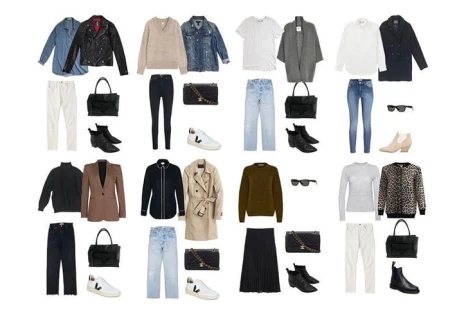
Four tops, three bottoms, two shaping layers and two outer layers create up to 48 theoretical combinations before footwear and accessories are counted. Not every result will be equally useful, but the calculation exposes weak purchases: if a garment works with only one bottom or one pair of shoes, it contributes little to the system. Different sellers and categories can be compared through the Mytrade.kz marketplace.
Before purchasing, photograph at least six complete looks in three versions: base only, base plus shaping layer, and the full outdoor combination. This simple review reveals pulling, uneven hems, excess bulk and colour conflicts more reliably than judging each item separately.
When every layer has a job, the outfit stays composed
A polished wardrobe for Almaty is built around sequence rather than quantity: a complete indoor base, one shaping layer, practical outerwear and a compact reserve. This approach allows by.olga.shop garments and accessories to be evaluated by how many real situations they support. For the next step, the previous guide to turning a business look into an evening outfit explains how to change the mood with a few fast accents.