
A working wardrobe has to solve more than one dress code. A normal week may include desk work, a client meeting, travel across Almaty, an informal lunch and an evening event. When garments are purchased as isolated outfits, the wardrobe grows while reliable combinations remain scarce. This guide shows how to build a compact capsule around real calendar demands, so each piece earns its place through fit, comfort and compatibility rather than novelty alone.
Start with the calendar, not a shopping list
A useful capsule reflects the life of its owner. Before choosing colours or silhouettes, review a typical four-week period and count how often you dress for formal meetings, routine office work, days with extensive walking and events after work. A woman who meets clients three times a week needs a different balance from someone working in a relaxed or hybrid environment.
Write down the five situations that account for most of your time. Then examine the by.olga.shop company profile on Mytrade.kz with those situations in mind. The practical question is not simply whether a garment looks attractive, but whether it closes a real gap in the weekly schedule.
A realistic weekly map may include:
- three ordinary office days;
- one presentation or client meeting;
- one day involving travel or extensive walking;
- one dinner or informal meeting after work;
- an occasional celebration or professional event.
This method prevents a common mistake: building a wardrobe for an imagined lifestyle while continuing to struggle with the clothes required for everyday work.
The unused-clothing problem is usually a compatibility problem
WRAP research found that the average UK adult owned approximately 118 clothing items, including underwear and hosiery, while 26% had not been worn during the previous year. The figure should not be treated as a universal measure for every country, but it illustrates how easily wardrobe volume can exceed practical use.
The Ellen MacArthur Foundation also reported that worldwide clothing utilisation—the number of times a garment is worn before it stops being used—fell by 36% over a 15-year period. A capsule addresses this problem by increasing the number of credible roles assigned to every item.
Use the three-by-four admission test
Before adding a garment, check whether it works with at least three existing pieces and supports four realistic outfits. A blouse that matches two pairs of trousers, one skirt and both blazers has a clear function. A blouse that only works with one special skirt may create another purchasing chain involving new shoes, outerwear and a bag.
The current clothing and accessory offers from by.olga.shop can therefore be compared by compatibility rather than as separate complete looks. This makes it easier to distinguish a useful addition from an attractive but isolated purchase.
A 15-piece core for a multi-purpose working wardrobe
The following structure is a planning model rather than a fixed rule. It covers transitional weather and excludes underwear, sportswear, home clothing and heavy winter outerwear. The quantities can be adjusted for workplace requirements and personal preferences.
Two jackets
- one structured blazer for presentations and formal meetings;
- one softer jacket for routine office days and less formal combinations.
Three bottoms
- two pairs of trousers with different silhouettes;
- one skirt that works with both jackets and several tops.
Five tops
- two shirts or blouses;
- two knitted tops;
- one simple T-shirt suitable for layering.
Five supporting garments
- two dresses: one business-oriented and one adaptable from day to evening;
- one fine-knit jumper;
- one cardigan;
- one trench coat or lightweight outer layer.
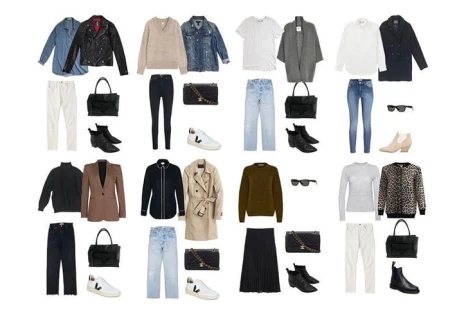
Five tops combined with three bottoms already create 15 basic pairings. Two jackets, two knitwear layers and accessories can change their level of formality without requiring a completely different outfit. The goal is not to wear every theoretical combination, but to produce at least 10 dependable outfits that feel comfortable and appropriate.
Fit must be tested in motion
A capsule fails when visually compatible pieces are uncomfortable during a real working day. When trying on trousers or a jacket, sit down, walk, reach forward, raise your arms and keep the garment on for at least 15–20 minutes. Check whether the waistband shifts, the jacket pulls across the back or the sleeves restrict movement.
Static product images rarely show how a hem moves, whether a bag changes the proportions of a jacket or how fabric behaves while walking. The by.olga.shop Reels collection can help assess garments and accessories from several angles before making a shortlist.
Check four fit zones first
- Shoulders: the seam should sit close to the natural shoulder line.
- Back: strong horizontal pulling may indicate insufficient room.
- Waist and hips: the garment should remain stable when sitting and walking.
- Sleeves and trouser length: proportions must work with the intended shoes.
A technically correct size is not enough if the garment only looks right while standing still. For a working capsule, mobility is part of appearance because discomfort quickly changes posture and confidence.
Three pairs of shoes and two bags can cover most transitions
The footwear component should be based on function rather than minor variations of the same style. A compact system may include one polished closed pair for formal meetings, one comfortable office pair and one option suited to walking or informal days.
Apply a minimum compatibility rule: every pair should work with at least two bottoms and one dress. The same principle applies to bags. One structured, practical bag may carry documents and daily essentials, while one smaller bag can support dinners or events after work.
To compare how scale, texture and accessories influence an outfit, the short-video section on Mytrade.kz can be used as a visual reference. The objective is not to copy an outfit exactly, but to observe which proportions and combinations could work with your existing clothes.
Build outfits around transitions, not isolated occasions
Routine office day
Combine trousers, a knitted top and the softer jacket. The jacket can be removed indoors without making the outfit look unfinished.
Client presentation
Use the structured blazer, trousers or skirt, a shirt and polished shoes. A stable shoulder line and controlled proportions usually communicate more professionalism than excessive decoration.
Workday with extensive travel
Choose the most comfortable trousers, a breathable top, cardigan and walking-friendly shoes. The outfit should remain presentable after several hours of movement.
Dinner after work
Keep the trousers and blouse, remove the blazer, replace the practical bag with a smaller one and add a distinctive accessory. Two changes can shift the outfit without requiring a full change of clothes.
Professional or social event
Use one of the dresses with a jacket and stronger accessories. A dress that works with both formal and relaxed elements is more valuable to a capsule than a highly specific design reserved for one occasion.
A 30-minute audit before any new purchase
- Lay out all potential capsule pieces, including shoes and bags.
- Create at least 10 complete outfits and photograph them.
- Identify garments that appear in only one combination.
- Record repeated gaps, such as a suitable jacket or versatile top.
- Buy only after confirming that the new item solves one of those gaps.
This process turns shopping into a measured decision rather than a reaction to an attractive image. When comparing products on the Mytrade.kz marketplace, assess not only colour and style, but also the number of outfits the item can support immediately.
For example, a jacket that works with three bottoms, two dresses and four tops has several routes into the wardrobe. A decorative garment that requires a new bag and new shoes may be less useful even if it creates a stronger first impression.
Fewer pieces only work when they last
WRAP states that extending the active life of clothing by nine months can reduce its carbon, water and waste footprints by up to 20%. This strengthens the practical case for checking fabric, seams, care instructions and colour stability before purchase.
Vivienne Westwood summarised the principle as: “Buy less, choose well, make it last.” In capsule planning, the phrase has a functional meaning. Buying less is only effective when each selected item fits correctly, survives regular use and can be maintained without unrealistic effort.
Further guidance on choosing, coordinating and caring for clothing is available in the by.olga.shop news and offers section. These materials can be used as a sequence: define the wardrobe gap, evaluate fit and quality, then establish the correct care routine.
When the wardrobe is ready before the working day begins
A successful capsule is not defined by a perfectly minimal number. It is defined by the absence of inactive pieces and the presence of reliable combinations for real situations. Fifteen garments, three pairs of shoes and two bags can provide a practical starting point, while colour, jewellery, texture and layering preserve individuality.
For by.olga.shop, suits, bags and accessories can be evaluated as connected parts of one wardrobe rather than unrelated purchases. Once the capsule has been assembled, correct care becomes essential because losing the shape or colour of one central jacket may remove several outfits from rotation.
The next useful step is the guide to preserving the fit, shape and colour of a women’s suit, which explains how storage and cleaning decisions affect the working life of the garment.