'%3e%3cpath%20d='M12.0683%2015.2949H11.015C10.9053%2015.2949%2010.8164%2015.3838%2010.8164%2015.4935V25.7849C10.8164%2025.8946%2010.9053%2025.9835%2011.015%2025.9835H12.0683C12.1779%2025.9835%2012.2668%2025.8946%2012.2668%2025.7849V15.4935C12.2668%2015.3838%2012.1779%2015.2949%2012.0683%2015.2949Z'%20fill='%230048FF'/%3e%3cpath%20d='M15.0278%2015.2949H13.9915C13.8819%2015.2949%2013.793%2015.3838%2013.793%2015.4935V25.7849C13.793%2025.8946%2013.8818%2025.9835%2013.9915%2025.9835H15.0278C15.1374%2025.9835%2015.2263%2025.8946%2015.2263%2025.7849V15.4935C15.2263%2015.3838%2015.1374%2015.2949%2015.0278%2015.2949Z'%20fill='%230048FF'/%3e%3cpath%20d='M9.09443%2015.2949H1.71809C1.60845%2015.2949%201.51953%2015.3838%201.51953%2015.4935V21.6128C1.51953%2024.0267%203.47634%2025.9834%205.89013%2025.9834H9.09448C9.20412%2025.9834%209.29304%2025.8946%209.29304%2025.7849V15.4935C9.29299%2015.3838%209.20407%2015.2949%209.09443%2015.2949Z'%20fill='%230048FF'/%3e%3cpath%20d='M24.342%2015.2949H16.9486C16.8389%2015.2949%2016.75%2015.3838%2016.75%2015.4935V25.7849C16.75%2025.8946%2016.8389%2025.9835%2016.9486%2025.9835H20.17C22.5838%2025.9835%2024.5406%2024.0267%2024.5406%2021.6129V15.4935C24.5406%2015.3838%2024.4517%2015.2949%2024.342%2015.2949Z'%20fill='%230048FF'/%3e%3cpath%20d='M15.016%206.07227H13.9798C13.8702%206.07227%2013.7812%206.16113%2013.7812%206.27082V13.6882C13.7812%2013.7978%2013.8701%2013.8868%2013.9798%2013.8868H15.016C15.1257%2013.8868%2015.2146%2013.7979%2015.2146%2013.6882V6.27077C15.2146%206.16113%2015.1257%206.07227%2015.016%206.07227Z'%20fill='%230048FF'/%3e%3cpath%20d='M12.0605%206.07227H11.0071C10.8975%206.07227%2010.8086%206.16113%2010.8086%206.27082V13.6882C10.8086%2013.7978%2010.8975%2013.8868%2011.0071%2013.8868H12.0605C12.1701%2013.8868%2012.259%2013.7979%2012.259%2013.6882V6.27077C12.259%206.16113%2012.1701%206.07227%2012.0605%206.07227Z'%20fill='%230048FF'/%3e%3cpath%20d='M23.5711%206.07227H16.9368C16.8272%206.07227%2016.7383%206.16113%2016.7383%206.27082V13.6882C16.7383%2013.7978%2016.8271%2013.8868%2016.9368%2013.8868H23.571C24.9125%2013.8868%2025.9999%2012.7993%2025.9999%2011.4578V8.50119C26%207.1597%2024.9125%206.07227%2023.5711%206.07227Z'%20fill='%230048FF'/%3e%3cpath%20d='M9.08494%206.07227H2.42892C1.08748%206.07221%200%207.15965%200%208.50114V11.4577C0%2012.7992%201.08748%2013.8867%202.42892%2013.8867H9.08494V13.8867C9.19457%2013.8867%209.28349%2013.7978%209.28349%2013.6881V6.27077C9.28349%206.16113%209.19457%206.07227%209.08494%206.07227Z'%20fill='%230048FF'/%3e%3cpath%20d='M20.1871%201.47349C18.9897%20-0.129579%2016.7113%20-0.459759%2015.1081%200.737715C14.8681%200.916974%2014.1377%201.46252%2013.1094%204.1681C13.109%204.16937%2013.1084%204.17064%2013.1079%204.17191C13.0397%204.35157%2013.173%204.54383%2013.3652%204.54383H20.6349C20.7291%204.54383%2020.8107%204.47766%2020.8298%204.38539C21.0343%203.40226%2020.8339%202.33941%2020.1871%201.47349Z'%20fill='%230048FF'/%3e%3cpath%20d='M12.4378%202.93607C11.6806%201.28298%2011.1489%200.885569%2010.9508%200.737694C9.34772%20-0.459731%207.06926%20-0.129601%205.87183%201.47346C5.22508%202.33944%205.02465%203.40224%205.22915%204.38542C5.24834%204.47764%205.32979%204.54386%205.42404%204.54386H11.7223C11.8052%204.54386%2011.8796%204.49231%2011.9084%204.41447C11.9384%204.33311%2011.9691%204.2509%2012.0006%204.16808C12.1533%203.76609%2012.2995%203.41209%2012.4385%203.09953C12.4616%203.04748%2012.4615%202.98792%2012.4378%202.93607Z'%20fill='%230048FF'/%3e%3c/g%3e%3cdefs%3e%3cclipPath%20id='clip0_4773_3494'%3e%3crect%20width='26'%20height='26'%20fill='white'/%3e%3c/clipPath%3e%3c/defs%3e%3c/svg%3e)
Free ad placement
EN


Free ad placement

Goods, services, cars, real estate and jobs

Create a seller page

EN



0

8

0



АвтоВазмаркет
AvtoVazmarket on Valikhanov is a supplier of auto parts and components for cars in Russia, Europe, Asia and the USA. For more than 15 years, the company has been operating in the Kazakhstan market, offering wholesale and retail supplies, parts selection, regional delivery and service replacement of auto parts.
The braking system is one of the most critical safety components of any vehicle. It allows the driver to reduce speed, avoid collisions, and maintain control during emergency situations. According to the World Health Organization (WHO), vehicle defects are among the contributing factors to road traffic accidents, while worn brake components significantly increase stopping distances and the risk of crashes.
According to specialists from Bosch Automotive and Brembo, more than 60% of vehicles inspected during scheduled maintenance show some degree of brake pad or brake rotor wear. Despite this, many drivers continue operating their vehicles without recognizing the early warning signs.
Using high-quality auto parts and inspecting the braking system regularly helps ensure road safety and prevents expensive repairs.
How Does a Car Braking System Work?
A modern braking system consists of several key components:
- brake pads;
- brake rotors (discs) or brake drums;
- brake calipers;
- brake cylinders;
- brake hoses;
- master brake cylinder;
- brake booster;
- brake fluid;
- electronic safety systems such as ABS, EBD, and ESP.
All of these components work together to safely slow and stop the vehicle.
What Types of Braking Systems Are There?
Today's passenger vehicles mainly use two types of braking mechanisms.
Disc Brakes
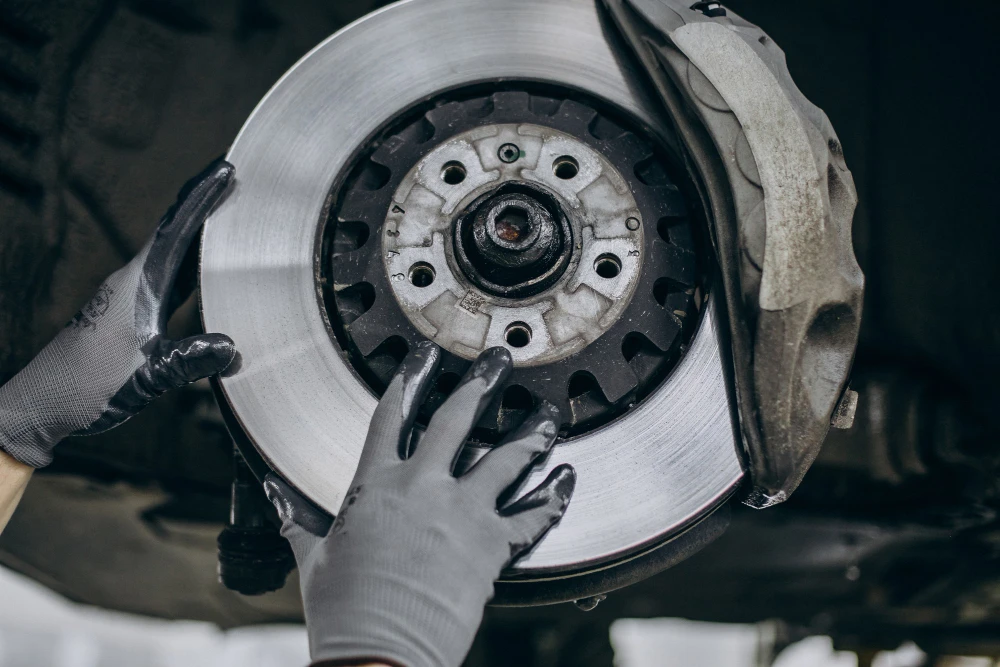
Disc brakes are the most common braking system found in modern vehicles.
Their operating principle is straightforward:
- when the driver presses the brake pedal, the brake caliper squeezes the brake pads against the rotating brake rotor;
- friction is created;
- the vehicle slows down.
Advantages:
- excellent braking performance;
- efficient heat dissipation;
- greater resistance to brake fade;
- easier maintenance.
Disc brakes are installed on virtually all modern vehicles from manufacturers such as Toyota, BMW, Mercedes-Benz, Audi, Hyundai, Kia, Volkswagen, Mazda, Lexus, and Honda.
Drum Brakes
Although gradually being replaced by disc brakes, drum brakes are still commonly used on the rear axle of many affordable vehicles.
Advantages:
- lower manufacturing cost;
- long service life;
- better protection from dirt and debris.
Disadvantages:
- slower heat dissipation;
- reduced performance during repeated hard braking;
- more complex maintenance.
What Is ABS and Why Is It Important?
ABS (Anti-lock Braking System) prevents the wheels from locking during emergency braking.
This allows the driver to:
- maintain steering control;
- reduce the risk of skidding;
- steer around obstacles while braking.
Today, ABS is standard equipment on nearly every new passenger vehicle.
What Are ESP and EBD?
Modern vehicles are also equipped with advanced electronic safety systems.
EBD (Electronic Brakeforce Distribution) automatically distributes braking force between the wheels depending on the vehicle's load.
ESP (Electronic Stability Program) helps maintain vehicle stability and reduces the likelihood of skidding on slippery roads.
According to Euro NCAP, vehicles equipped with ESP reduce the risk of losing control by approximately 30–40%.
When Should Brake Pads Be Replaced?
Brake pad lifespan depends largely on driving conditions.
On average:
Front brake pads last approximately:
- 30,000–50,000 kilometers.
Rear brake pads typically last:
- 50,000–70,000 kilometers.
Vehicles driven primarily in heavy city traffic may wear through brake pads nearly twice as fast.
When Should Brake Rotors Be Replaced?
Most manufacturers recommend inspecting brake rotor thickness every time brake pads are replaced.
The average service life is:
- 60,000–120,000 kilometers.
Actual lifespan depends on factors such as:
- rotor quality;
- driving style;
- vehicle weight;
- operating conditions.
Once rotor thickness falls below the manufacturer's minimum specification, replacement is necessary.
Common Signs of Brake System Wear
Do not postpone an inspection if you notice any of the following symptoms:
- squealing or grinding noises while braking;
- brake pedal vibration;
- increased stopping distance;
- the vehicle pulling to one side;
- metallic scraping sounds;
- low brake fluid level;
- illuminated brake warning light.
Ignoring these warning signs can lead to serious mechanical failures and dangerous driving conditions.
Why Is It Important to Replace Brake Fluid Regularly?
Brake fluid naturally absorbs moisture over time.
This can result in:
- a lower boiling point;
- reduced braking efficiency;
- corrosion inside the braking system;
- brake failure under heavy braking conditions.
Most vehicle manufacturers recommend replacing brake fluid every 2 years or every 40,000–60,000 kilometers.
Which Brake Component Manufacturers Are Considered the Best?
Several manufacturers have earned an outstanding reputation worldwide, including:
- Brembo
- ATE
- Bosch
- TRW
- Ferodo
- Textar
- Akebono
- Zimmermann
Many of these brands also supply original equipment (OEM) components to major automotive manufacturers.
How Can You Extend the Life of Your Braking System?
Automotive technicians recommend:
- avoiding unnecessary hard braking;
- checking brake pad thickness regularly;
- monitoring brake rotor condition;
- replacing brake fluid on schedule;
- cleaning brake calipers during maintenance;
- installing only high-quality brake components;
- performing a complete brake system inspection at least once a year.
Routine maintenance significantly improves both vehicle safety and braking performance.
Where Can You Buy Quality Brake Parts?
Brake pads, brake rotors, calipers, wheel cylinders, brake hoses, brake fluid, ABS sensors, and many other braking components can be found in the auto parts catalog, which offers products from numerous suppliers for most popular vehicle brands.
Final Thoughts
A properly functioning braking system is essential for the safety of the driver, passengers, and everyone else on the road. Even minor wear of brake pads, rotors, or brake fluid can significantly reduce braking performance and increase the risk of an accident. Regular inspections, timely replacement of wear components, and the use of high-quality parts help maintain vehicle reliability, reduce repair costs, and ensure confident driving under all road conditions.
At Mytrade.kz, you can find a wide selection of braking system components for most popular vehicle brands, compare offers from multiple suppliers, and choose reliable replacement parts at competitive prices.
Read also: What Types of Car Engines Are There and Which Ones Are Considered the Most Reliable?.