
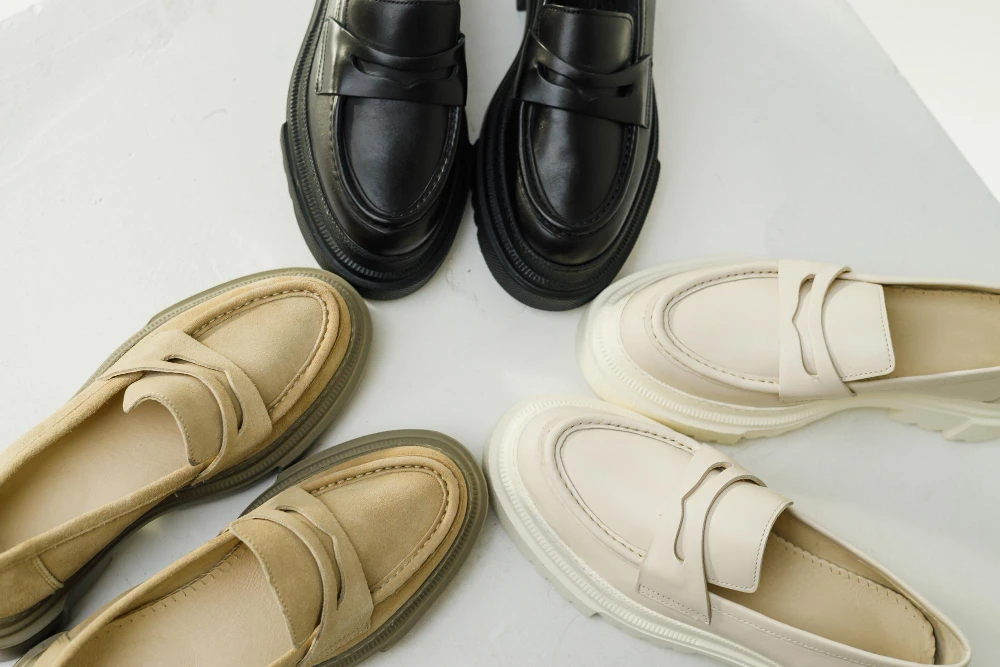
White, beige and black shoes are all described as wardrobe essentials, yet they perform very differently once they meet real clothes. A colour that looks neutral on a product page may create excessive contrast, clash with the undertone of trousers or demand more cleaning than expected. This guide helps shoppers compare the three options through outfit compatibility, seasonality, maintenance and expected frequency of wear before committing to another pair.
Start with the clothes closest to the shoes
The most useful shoe colour is not determined by the total number of colours in a wardrobe. What matters most is the palette around the lower half of the outfit: trousers, jeans, skirts, tights and long outerwear. Someone may own several white shirts, but that does not automatically make white footwear the strongest option when most trousers and coats are black, charcoal or dark brown.
A practical first step is to review the available shapes and materials on the PASSAGE footwear storefront on Mytrade.kz. Colour cannot be assessed separately from construction: a slim black loafer creates less visual weight than a bulky black trainer, while an off-white sole may appear softer than a bright optical-white one.
The ten-outfit compatibility audit
- Select ten outfits worn during the previous two weeks rather than combinations saved for special occasions.
- Assign white, beige and black footwear to each outfit.
- Give two points when the colour works without changing another item.
- Give one point when it works only after replacing a bag, belt, jacket or pair of trousers.
- Give zero points when the shoes divide the outfit visually or conflict with its temperature.
A possible maximum of 20 points makes the comparison easy to interpret. A colour scoring 16–20 is likely to function as a regular base, while a result below 12 suggests that the pair will depend on a narrower group of outfits. This is a personal wardrobe test rather than a universal fashion rule.
White works best when the outfit already contains visual lightness
White footwear supports blue denim, grey knitwear, pale tailoring, sportswear and dresses with clear or pastel colours. It can make a dense outfit feel lighter and create a clean break between clothing and the ground. However, against dark trousers and a dark coat, bright white shoes become a deliberate focal point rather than a discreet neutral.
An Ohio State University study asked 142 participants to choose colours for seven components of an athletic shoe. Although numerous options were available, participants used approximately four colours on average and generally selected closely related combinations. Lead researcher Xiaoyan Deng summarised the preference clearly: “Most people like to match colors very closely.”
This behaviour explains why white footwear is easier to repeat when another light element appears in the outfit, such as a shirt, print, bag, sole detail or jacket. Different combinations can be viewed in the PASSAGE Reels collection featuring footwear models, where proportions and shades are easier to assess in motion.
When white becomes less practical
- The wardrobe consists mainly of deep brown, burgundy, black and muted autumnal colours.
- The chosen model combines bright fabric, textured panels and a light sole that require separate cleaning.
- The shopper prefers low-contrast outfits with no visible colour break at the feet.
Beige adapts well, provided its undertone is correct
Beige can connect cream, camel, olive, chocolate, sand and classic blue denim without producing the sharp boundary created by white or black. It is often effective in spring, summer and transitional wardrobes because it keeps the lower part of the outfit visually light while remaining less striking than pure white.
The difficulty is that beige is not one colour. Stone beige may suit cool greys and faded denim, sand works naturally with linen and warm neutrals, while caramel is closer to brown. A pink-beige shoe can look disconnected beside yellow-beige trousers even though both products are labelled neutral.
Pantone’s seasonal colour reporting describes trans-seasonal neutrals as a foundation on which a wider palette can be built. Applied to footwear, the principle means that beige becomes flexible only when its undertone supports the colours already repeated in the wardrobe. Current shades and constructions can be compared among the available footwear offers from PASSAGE.
A three-item undertone check
- Place the shoe beside the pair of trousers worn most frequently.
- Compare it with the main spring or autumn coat.
- Check whether it relates naturally to the everyday bag or belt.
If the shade coordinates with at least two of these three items, it has a stronger chance of becoming a frequently worn base. Additional guidance on building coherent everyday combinations is available in the PASSAGE news and shopping guides section.
Black is strongest when the wardrobe has a dark visual anchor
Black footwear connects naturally with charcoal trousers, dark denim, navy tailoring, leather accessories and deep-coloured outerwear. It creates continuity in office, urban and evening combinations and usually scores well when dark trousers appear in at least half of the ten outfits being assessed.
Black does not automatically mean low maintenance. Pale dust is visible on matte surfaces, dried water marks can remain on soles, and scratches may stand out on smooth or glossy materials. Shape also changes the result: a heavy black platform may dominate a pale dress, while a streamlined flat or loafer can provide a controlled contrast.
Examples of how colour and silhouette interact across different products can be explored in the short-form video library on Mytrade.kz.
Versatility has a measurable financial value
The 2026 AlixPartners and Footwear Distributors and Retailers of America survey found that 93% of respondents intended to purchase casual footwear, while 50% considered it a must-buy category. The same U.S. research reported that 67% had abandoned a purchase because of cost, 65% because their size was unavailable and 34% because the item was not discounted.
These figures do not describe the Kazakhstan market directly, but they illustrate why shoppers increasingly expect one pair to work across several situations. If one option supports eight regular outfits and another works with only three, the first has considerably greater potential for repeated wear, even before price is considered. Broader footwear categories and sellers can be compared through the English-language Mytrade.kz marketplace.
Which colour should receive the highest score?
- Choose white when light denim, grey, blue, sportswear and clean pale shades dominate daily outfits.
- Choose beige when the wardrobe is built around cream, brown, olive, camel and other warm or natural tones.
- Choose black when dark trousers, structured clothing, dense denim and deep-coloured outerwear appear most often.
- When two colours receive equal scores, compare cleaning frequency, weather exposure and the number of seasons in which each pair can be worn.
- Do not judge a supposedly neutral colour against one carefully styled outfit; test it against an ordinary working week.
The right neutral should reduce decisions, not create new ones
There is no single winner for every wardrobe. White is effective in light and denim-based combinations, beige creates continuity across natural palettes, and black provides structure for dark or business-oriented clothing. When selecting footwear, clothing or accessories from PASSAGE, colour should therefore be assessed together with shape, material, maintenance and the situations in which the item will actually be used.
Before adding another neutral pair, it is worth identifying which footwear role is still missing. The previous guide to building a four-pair footwear wardrobe provides a useful starting point for that audit.