Ordering shoes for delivery is convenient only when every important detail is confirmed before payment. A product photograph cannot prove that the size will fit, the parcel will contain the correct model or an unexpected delivery message is genuine. This guide explains how to check the seller, provide accurate measurements, record the order terms, protect the payment, monitor the shipment and inspect the shoes before wearing them outside.
Treat the order as a chain of verifiable decisions
Kazakhstan’s online retail market continues to expand. The Bureau of National Statistics reported that retail e-commerce reached KZT 3,768.8 billion in 2025 and represented 14.3% of total retail trade. Clothing, footwear and sporting goods accounted for 12.4% of marketplace sales. Buyers comparing sellers and product ranges can begin with the Mytrade.kz marketplace for Kazakhstan.
Large market figures do not remove the risks of an individual purchase. A buyer still needs to identify who is selling the product, where the business operates and which communication channel is being used. PASSAGE offers shoes, clothing and accessories for customers in Almaty, Esik and the Almaty Region. Its stated business information can be reviewed through the verified PASSAGE company storefront.
Delivery terms deserve the same attention as the product itself. DHL’s 2025 international study covered 24,000 online shoppers across 24 markets. It found that 81% would abandon a purchase without their preferred delivery option, while 79% would leave if the return process failed to meet expectations. DHL eCommerce CEO Pablo Ciano summarised the operational issue clearly: “Logistics plays a crucial role in this process.”
Build a fit profile before asking for a size
A familiar size number is only a starting point. Last shape, toe-box width, upper construction and lining thickness can change the fit even when two pairs carry the same label. The American Podiatric Medical Association recommends measuring both feet later in the day and selecting for the larger foot.
Send the seller five useful measurements and details
- Measure both feet from the back of the heel to the longest toe.
- Record the width across the broadest part of each foot.
- Mention a high instep, wide forefoot or other relevant fitting concern.
- State which socks or tights will normally be worn with the shoes.
- Give an example of a brand and size that already fits comfortably.
Ask how the measurements compare with the inner length and width of the selected model rather than relying only on the number printed on the box. Available styles can be reviewed among the current footwear listings from PASSAGE, but the specifications of the exact pair should still be confirmed directly.
Images taken from one angle may conceal the depth of the toe area, the height of the heel counter or the flexibility of the sole. Short-form video can provide additional visual context by showing the proportions of a model in motion. Buyers can use the PASSAGE product videos and Reels as an extra comparison tool before placing a request.
Create a written order record before transferring money
A safe order should be understandable without reconstructing several calls or voice messages. Ask the seller to confirm the final details in one written message. This record helps both parties identify what was agreed and reduces disputes caused by an incorrect colour, size or delivery address.
The confirmation should include
- the exact model name or product reference;
- colour, size and quantity;
- product price, delivery charge and total amount;
- payment method and recipient details;
- the customer’s name, telephone number and delivery address;
- the expected shipping method and tracking procedure;
- the process to follow if the size is unsuitable or a defect is found.
Payment habits in Kazakhstan are varied. In 2025, debit cards and electronic bank transfers represented 33.7% of reported e-commerce payments, cash accounted for 22.6%, and online credit-card payments represented 21.3%. Whatever method is used, the customer should retain the electronic receipt, bank confirmation and order correspondence.
Stock availability and commercial information may change, so the buyer should check the latest PASSAGE news and customer offers and then request confirmation for the specific model being ordered.
Separate genuine delivery updates from fraudulent messages
A common warning sign is an unexpected message claiming that a parcel is delayed because of an unpaid fee, an incomplete address or a failed delivery attempt. The message may contain a button leading to a convincing copy of a courier website. The United States Federal Trade Commission advises consumers to verify delivery information independently rather than entering payment details through an unsolicited message.
Open the retailer account or carrier website manually and enter the tracking number yourself. Do not provide a card security code, banking password or one-time SMS code to a seller, courier or unknown contact. If additional payment is requested, compare the amount and order number with the written confirmation before taking any action.
Customers who want to compare how different sellers present products in video format can browse the short product videos across Mytrade.kz. Visual content can support a decision, but payment and delivery instructions still need independent verification.
Use tracking as an active control tool
Official statistics show that direct delivery to the buyer represented 46.1% of e-commerce fulfilment methods in Kazakhstan in 2025, while collection from a sales or service point represented 34.7%. In either case, the buyer should receive a shipment number, collection notice or another traceable confirmation.
- Enter the tracking number only on the carrier’s official website or application.
- Check that the destination city and recipient details are correct.
- Compare any courier call with the order and shipment numbers.
- Save screenshots if the parcel status stops updating.
- Contact the seller through the original communication channel if the information conflicts.
Before delivery day, establish whether another person may accept the parcel, whether inspection is possible at handover and what happens if the outer packaging is visibly damaged. These details prevent rushed decisions when the courier arrives.
Inspect the parcel before the shoes enter daily use
Keep the box, labels, inserts and payment evidence until the purchase has been fully checked. If the packaging is crushed, wet or torn, photograph every side before opening it. Recording one continuous unpacking video may help show the original condition of the parcel and its contents.
A practical seven-point inspection
- Confirm that the model, colour and size match the order record.
- Compare the markings on both shoes with the label on the box.
- Check the uppers for scratches, stains, tears and deformation.
- Inspect seams and the joint between the upper and the sole.
- Place both shoes on a flat surface and check their stability.
- Confirm that insoles, laces, straps and accessories are complete.
- Photograph any defect before removing labels or packaging.
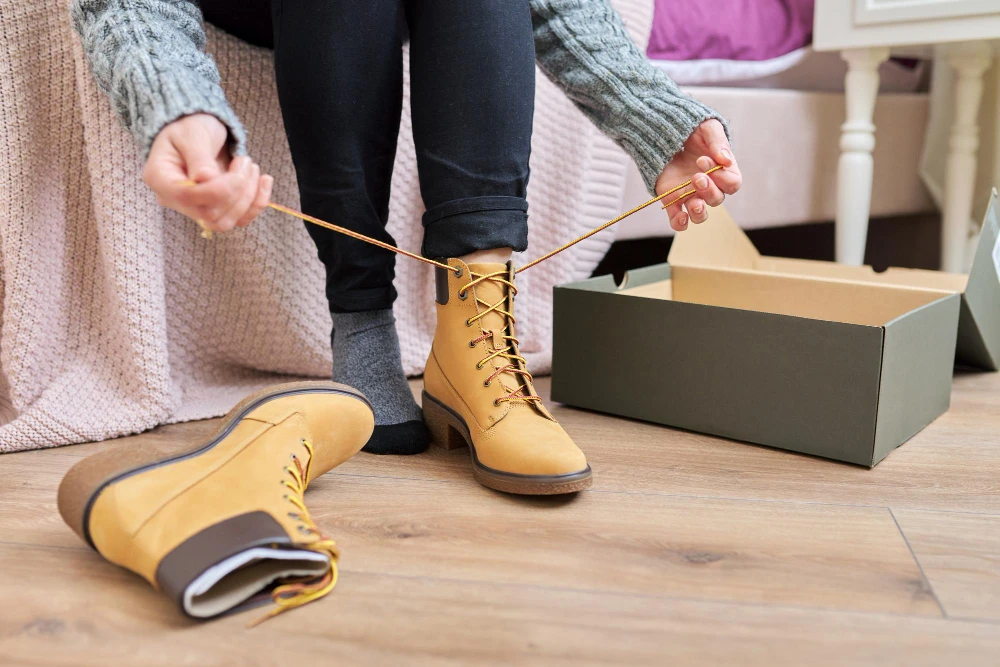
Try the shoes indoors on a clean surface and wear the intended type of sock. Walk for several minutes and assess heel movement, toe space, lateral pressure and overall stability. The APMA advises that shoes should feel “comfortable and supportive right away”; a painful or unstable fit should not be treated as a normal breaking-in stage.
Preserve the evidence needed for an exchange or return
Kazakhstan’s general consumer guidance states that an unused non-food product of proper quality may be exchanged or returned within 14 days when its presentation is preserved and proof of purchase is available. Evidence can include a receipt, card transaction, electronic confirmation, photographs, video or correspondence with the seller.
Contact the seller in writing and state the order number, receipt date, identified problem and requested solution. Avoid wearing the shoes outdoors, removing labels or discarding the box before deciding whether the pair is suitable. PASSAGE customers should clarify the applicable procedure for the particular purchase before completing payment.
A calm delivery starts with a disciplined request
A convenient shoe order is built from small checks performed in the correct sequence: identify the seller, measure both feet, verify the exact model, document the total amount, use a traceable payment method, monitor the shipment and inspect the pair before outdoor wear. This approach does not make the process complicated; it prevents uncertainty from being discovered after the money has been transferred.
Before submitting the next order, buyers can also use the ten-question checklist for a considered shoe purchase to decide whether the pair meets a real wardrobe need and is suitable for its intended use.