Shoe color can alter the balance of an outfit before heel height, fabric or accessories are even considered. A pair that blends with the skin, trousers or hosiery allows the eye to follow one continuous line, while a sharp contrast at the ankle creates a visible stopping point. This guide is for shoppers comparing shoes for dresses, cropped trousers and suits who want more balanced proportions without sacrificing comfort. PASSAGE recommends judging every shade as part of the complete outfit rather than as an isolated color.
First decide what the shoes should do
Not every outfit needs the same visual result. In one look, the shoes should disappear into the silhouette and make the legs seem longer. In another, they should become the focal point. Problems arise when a shopper chooses an accent color but expects it to behave like a neutral shade.
A useful starting point is to identify the intended role of the pair before comparing models. Should it continue the leg, extend the trouser line or deliberately interrupt the outfit? The available shapes, materials and colors can be reviewed on the PASSAGE company profile on Mytrade.kz.
Visual length depends on where the eye stops
The eye reads a silhouette through boundaries: the hem of a skirt, exposed skin, socks, ankle straps and the upper edge of a shoe. Every strong change in color can create another horizontal division. When several divisions appear below the knee, the visible leg line may seem shorter even though the person’s actual proportions have not changed.
Research by Peter Thompson and Kyriaki Mikellidou demonstrates how strongly surrounding lines can affect perceived dimensions. In their experiment, a vertically striped rectangle had to be extended by 7.1% to appear equal in height to a horizontally striped figure. The difference recorded for perceived width was 4.5%. These numbers are not a formula for footwear, but they confirm that visual context can change the way size and proportion are judged.
A quick boundary count
- A skirt hem creates the first visual division.
- A contrasting sock or hosiery shade creates another.
- An ankle strap can add a clear horizontal line.
- A strongly contrasting sole may form the final block.
The fewer abrupt transitions there are below the knee, the easier it is for the eye to read the lower body as one continuous shape.
Skin-tone footwear is a range, not one beige shade
With bare legs, pumps, ballet flats, mules and sandals can visually continue the leg when their color is close to the wearer’s skin. The important factor is not whether the product is labeled “nude,” but whether its depth and undertone create a soft transition. Depending on the person, the useful neutral may be rose beige, honey, caramel, bronze, coffee or deep brown.
Wardrobe stylist Gabbi Maragos explains her approach to dramatic clothing: “I will choose a nude heel to pair with a bold or dramatic dress.” The principle is simple—the footwear supports the outfit without creating a separate color block. Suitable shades can be compared among the current footwear offers from PASSAGE.
Three checks are more reliable than the color name
- Compare the shoe with the leg in daylight as well as indoor lighting.
- Check whether the undertone appears warm, cool or neutral against the skin.
- Photograph two neighboring shades from several steps away instead of judging them only at close range.
An exact match is unnecessary. A shoe one or two tones deeper than the skin may create a smoother line than a pale beige pair that produces obvious contrast.
Trousers create a different color reference
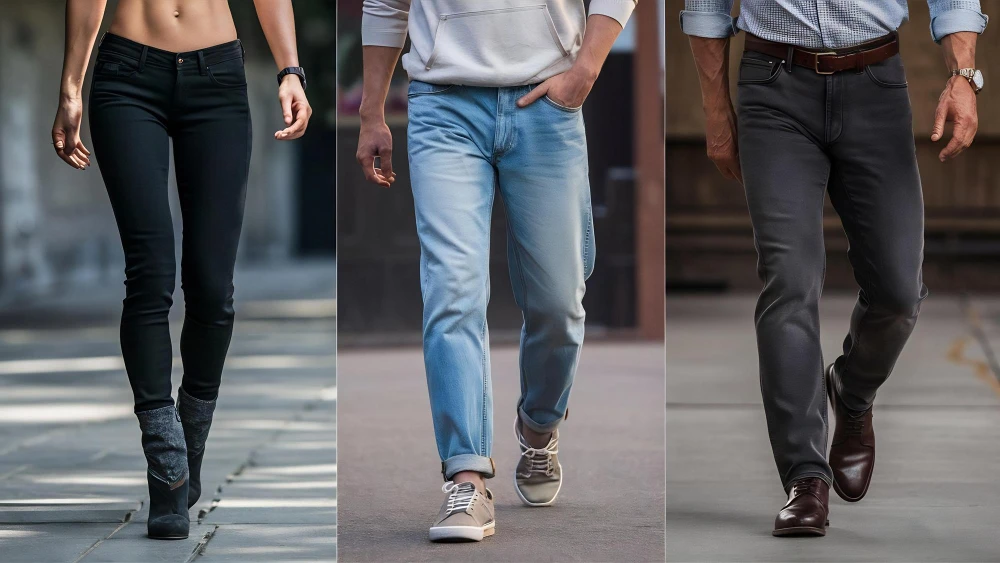
When the leg is covered, matching the skin becomes less important than continuing the color of the fabric. Black loafers under black trousers create a single uninterrupted column. Chocolate ankle boots can extend brown trousers, while cream sneakers may connect more naturally with pale denim than a heavy black pair.
The trouser hem must also be considered in motion. Cropped trousers may appear continuous while standing still but expose the ankle with every step. Video gives a more realistic impression of this transition than a close-up product image, so shoppers can study different silhouettes in the PASSAGE Reels collection.
Hosiery follows the same principle
Black shoes with black tights usually form one visual block. The same shoes worn with a bare light-toned leg create a much stronger boundary. Opaque brown, gray or burgundy hosiery can also be extended with footwear from the same color family without requiring an exact match.
Black and white do not have fixed visual effects
Black shoes are often described as universally slimming, but their effect depends on the colors around them. They can lengthen a dark trouser line, yet a closed, chunky black shoe worn with a short pale dress may make the foot look visually heavy and place a strong stop at the ankle.
White footwear behaves in the opposite way only when the surrounding outfit is dark. With white or cream trousers, it can preserve continuity. With cropped black trousers, it becomes the brightest point in the lower half of the outfit. Neither color automatically lengthens or shortens the legs; contrast determines the result.
Soft metallic shades offer another option. Champagne, muted gold and gentle silver may function as flexible neutrals, particularly for evening outfits. More color combinations and styling references can be explored in the short-video section on Mytrade.kz.
Shoe construction can strengthen or cancel the color effect
Two shoes in an identical shade may produce different proportions because the eye also notices the vamp, toe, sole and straps. Stylist Samantha Dawn notes that a V-shaped vamp makes a pointed toe appear sharper and “will elongate the legs even more.” Color continuity works best when the construction supports the same direction.
- A low or V-shaped vamp exposes more of the upper foot and extends the visible leg line.
- A pointed or almond toe directs the eye forward and can make the foot appear longer.
- A wide contrasting ankle strap creates a noticeable horizontal interruption.
- A thick white or black sole can turn a neutral upper into a strong visual accent.
- Contrasting socks add another color block between the leg and the shoe.
PASSAGE presents footwear made from suede, textile and combined materials, so shade should be assessed together with texture. Matte suede can appear softer and deeper than smooth material in a similar color. New styling materials are available in the seller’s news and offers section.
A 60-second fitting-room comparison
- Try the shoes with the trousers, dress or hosiery they will be worn with most often.
- Stand two or three steps away from the mirror rather than examining only the foot.
- Take a full-length photo with the phone positioned around waist level.
- Compare two colors without changing the outfit, lighting or camera angle.
- Notice where the eye lands first: the shoe, the ankle or the complete silhouette.
A photograph taken from above exaggerates the foot and shortens the visible leg, so it is not a reliable comparison. Keeping the camera position and posture unchanged makes the difference between two shades easier to evaluate. Models from different sellers can also be reviewed through the Mytrade.kz marketplace.
The best shade connects the shoe to the whole outfit
Making the legs appear longer does not require a high heel. A color related to the skin, trousers or hosiery, combined with a clean vamp and limited horizontal contrast, can create the same direction in flats, sneakers and low-heeled shoes. PASSAGE shoppers should therefore compare color, toe shape, straps and sole design as one system. When the goal is to make footwear the main feature instead, the balance between contrast and simplicity is explained in the previous guide to using statement shoes in a simple outfit.