Office shoes have to pass two tests: they must look appropriate in a meeting and remain comfortable through the commute, stairs, hard floors and several hours of sitting or standing. This guide is for anyone who no longer wants to choose between a polished outfit and foot comfort. It explains which alternatives to traditional pumps work at different levels of formality, which measurements matter during a fitting and how to judge whether a pair will still feel wearable late in the day. Start with the PASSAGE store profile on Mytrade.kz.
Judge the construction before the style name
A shoe may be described as classic or comfortable and still fail in daily use. The decisive areas are the toe box, the way the upper holds the midfoot and heel, and the behaviour of the sole on hard surfaces. Guy’s and St Thomas’ NHS Foundation Trust recommends about 1 cm of space beyond the longest toe. Its practical rule is: “A shoe needs to hold on to you, and you should not be holding on to it.”
This changes how slip-ons should be assessed. A loafer that stays on only because it squeezes the toes is not a useful office solution. A better model has a deeper vamp, a stable heel cup and sufficient width across the forefoot. PASSAGE offers classic and everyday footwear, so the current PASSAGE footwear selection can be used to compare constructions rather than appearance alone.
Five office-ready alternatives to conventional pumps
Structured loafers
Loafers work with tailored trousers, midi skirts and restrained dresses. Choose a rounded or softly squared toe. The heel should remain secure during a fast step, while the upper should not crease directly across a sensitive joint.
Derbies and brogues
Laces allow the fit to be adjusted over the instep. This is useful when the foot swells slightly during the day or when one foot has more volume than the other. A slim sole keeps the silhouette businesslike without forcing the forefoot into a narrow shape.
Mary Janes
A strap across the instep provides a clear fastening point. Very shallow ballet flats can make the toes grip to keep the shoe from slipping; a Mary Jane usually offers more control while retaining a refined appearance.
Minimal trainers
Where the dress code allows them, plain trainers can replace both athletic-looking shoes and stiff pumps. One-colour uppers, limited decoration and a moderately cushioned sole usually look more office-appropriate. Different silhouettes are easier to judge in motion through the PASSAGE Reels collection.
Low block heels and ankle boots
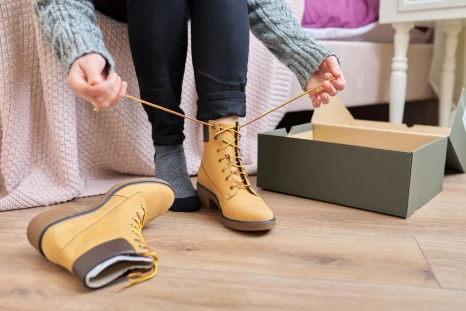
If a heel is expected, width and height should be considered together. NHS guidance advises keeping heels below 4 cm and notes that a wider heel is more stable. In cooler weather, a simple ankle boot with a broad heel and non-tapered toe can perform the same visual role as a pump.
Four figures that make the fitting less subjective
- 1 cm: the approximate clearance recommended between the longest toe and the front of the shoe, allowing the foot to lengthen during walking.
- Under 4 cm: a practical upper limit for heel height in NHS footwear guidance. A broad base is generally more stable than a narrow one.
- More than 75%: the share of everyday walking or standing time for which Guy’s and St Thomas’ advises wearing sensible footwear rather than reserving supportive shoes for only part of the day.
- 1 hour or 4 hours: NIOSH describes prolonged standing as more than one continuous hour or more than four hours across a workday. Its review linked this pattern with fatigue, leg swelling, muscle pain and lower-back discomfort.
These numbers do not replace an individual fitting, but they expose common buying errors. A pair that touches the toes while standing is unlikely to improve during a commute, and a shoe that feels unstable in the fitting area will not become more controlled on stairs. Further styling references can be found in the short-video section on Mytrade.kz.
Why wearing time matters as much as heel height
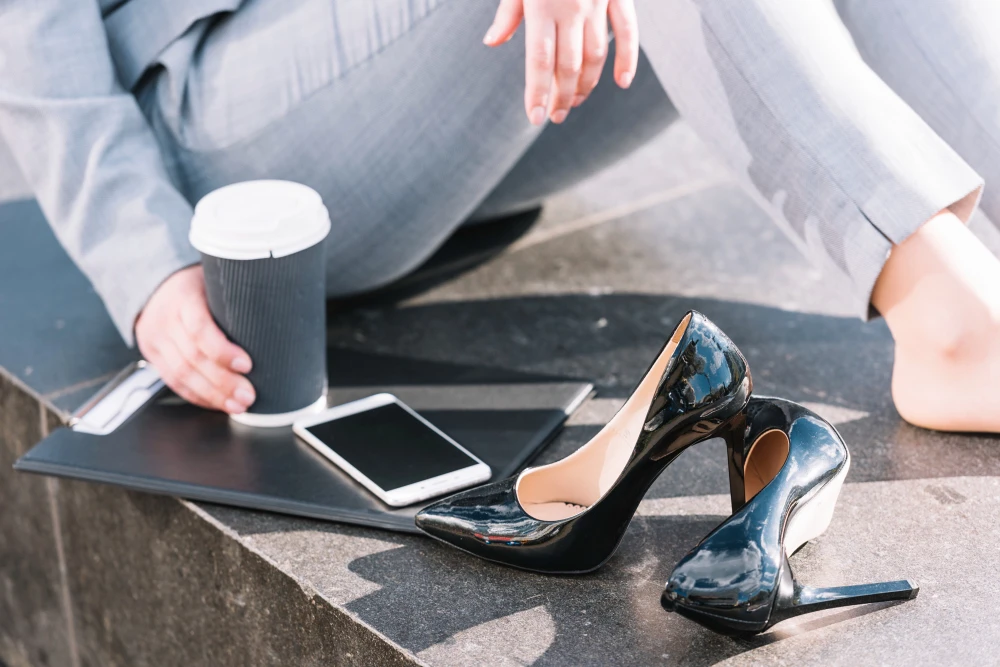
A 2024 study followed 50 habitual high-heel wearers aged 20 to 30 for six hours. Participants recorded discomfort every hour. Mild overall discomfort became noticeable after roughly 3.5 hours, while 7.5 cm appeared as a threshold at which overall body pain became significant. The result does not predict an identical response for everyone, but it explains why a heel that feels acceptable for a short meeting may be unsuitable for a full office day.
A practical strategy is to match the shoe to the longest part of the schedule. A higher heel may be reserved for a brief appointment, while a loafer, lace-up or refined trainer handles the commute and routine movement. NIOSH researcher Robert B. Dick wrote that “dynamic movement appeared to be the best solution” for reducing risks associated with prolonged standing. Footwear helps, but changing position also matters. Product formats can be compared through the English version of Mytrade.kz.
A ten-minute test before buying
- Try on both shoes with the socks or hosiery normally worn at work.
- Check the 1 cm toe allowance while standing, not only while seated.
- Walk quickly, turn and rise onto the forefoot; the heel should not lift repeatedly.
- Press around the toe box to confirm that the upper is not resting on the nails or joints.
- Check that the sole bends near the forefoot rather than collapsing through the middle.
- Inspect internal seams and the top of the heel counter for rubbing points.
- Do not rely on breaking in a pair that already creates pressure during the fitting.
The aim is not simply to find the softest shoe, but a shape that supports the foot without forcing it into place. Comfort should come from correct length, sufficient width, secure fastening and a sole that remains stable under load. PASSAGE can also be followed through its news and product updates.
The pair that still works after the meeting
A practical office shoe should support the outfit without dominating the working day. Loafers suit formal wardrobes, lace-ups provide adjustability, Mary Janes add secure fastening, minimal trainers fit modern smart casual, and low block heels preserve a traditional silhouette with greater stability. The strongest choice matches the dress code, the foot shape and the real distance travelled between home and work. When evaluating a pair from PASSAGE, prioritise fit, fastening and heel control instead of expecting discomfort to disappear later. For a separate checklist focused on higher step counts, read the previous guide to shoes for long walks.