
A crowded wardrobe can create the illusion of choice while making everyday dressing harder. The problem is rarely the number of garments. It is usually the absence of connections between them: a blouse needs a different skirt, a suit does not suit the wearer’s routine, and an attractive bag belongs to an outfit that was never completed. This article is for women who want fewer morning doubts, more usable combinations and clearer purchasing decisions. In Almaty, by.olga.shop approaches clothing as part of a complete look rather than as an isolated item.
The real problem is not storage capacity but wardrobe compatibility
Kazakhstan’s Bureau of National Statistics reported that retail e-commerce reached KZT 3.7688 trillion in 2025 and represented 14.3% of total retail trade. Clothing, footwear and sporting goods accounted for 12.4% of marketplace sales. The figures show how accessible fashion purchasing has become, but easy access does not guarantee useful choices. When browsing the Mytrade.kz marketplace, it is worth evaluating each item by the outfits it can create, not only by its appearance on its own.
International wardrobe research illustrates the same mismatch between ownership and use. WRAP found that the average UK adult owned 118 clothing items, while 26%, or approximately 31 pieces, had not been worn for at least a year. These are UK figures rather than Kazakhstan-specific data, but they demonstrate an important pattern: wardrobe volume and wardrobe usefulness are different measurements. The by.olga.shop news and offers section can be used to explore clothing through real outfit scenarios rather than through accumulation.
Too many separate options increase the number of decisions
A full rail forces the wearer to compare colours, lengths, fabrics, dress codes and accessories every morning. Fashion stylist Rhianna Faye described the problem to Harper’s Bazaar as having “too many options and not enough staple pieces.” When dependable foundation garments are missing, every expressive item requires a new supporting purchase.
Four signs that a wardrobe contains products but not outfits
- Several garments perform the same function, while an essential layer or suitable bottom is missing.
- Most pieces work for imagined occasions rather than the wearer’s actual week.
- Colours look attractive individually but do not form a repeatable palette.
- An item can be worn only after buying different shoes, a bag or another garment.
Before choosing from the current by.olga.shop listings, a buyer can ask one practical question: will this piece work with at least three items already in the wardrobe? If the answer is unclear, the purchase may add quantity without increasing the number of usable looks.
A compatibility score reveals which garments work hardest
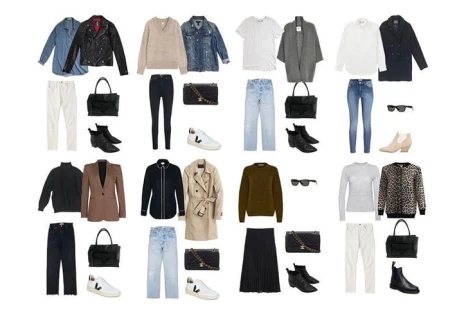
Consider a wardrobe with five tops, three bottoms and two jackets. In theory, these pieces can create up to 30 combinations. In practice, the total falls quickly when colours conflict, lengths distort the silhouette or fabrics belong to different levels of formality. The most valuable garment is therefore not always the most striking one. It is often the piece that connects several other items.
Use the 3–2–1 test before paying
- Name three outfits that can be created with clothes already owned.
- Identify two genuine situations in which the item will be worn.
- State one specific wardrobe gap that the purchase will close.
Vogue Business quoted fashion-community executive Alex Ropes saying that basics should work “with other basics really effortlessly.” The principle does not require an all-neutral wardrobe. It means that foundational garments should reduce friction and allow brighter pieces or accessories to remain wearable. Different proportions and layering ideas can be observed in the short-video collection on Mytrade.kz.
A 30-minute audit is more useful than another spontaneous purchase
Start with the coming seven days rather than the entire wardrobe. List the situations that are actually scheduled: work, errands, a meeting, an evening event or a relaxed weekend. Then assemble one complete outfit for each situation and photograph it. The gaps will become more visible than they are when every garment remains on a hanger.
- Separate the five pieces worn most frequently.
- Place their compatible tops, bottoms and layers beside them.
- Identify garments that have no suitable partner.
- Mark repeated items that perform exactly the same role.
- Write a purchasing list based only on the missing connections.
Photographs and video are especially useful because they reveal movement, proportion and the visual weight of accessories. Through by.olga.shop Reels videos, a customer can assess how suits, everyday garments, bags and accessories work as one composition rather than as unrelated products.
The strongest buying rule is to complete an outfit, not start another one
A useful purchase should reduce the number of unresolved combinations. Before checkout, check whether the garment is comfortable while sitting and walking, whether it fits the wearer’s normal dress code and whether it creates additional expenses. A discounted skirt is not economical if it requires new shoes, a different top and a special jacket before it can leave the wardrobe.
- Buy for the life you currently lead, not for an undefined future occasion.
- Check fit and movement, not only the mirror image from the front.
- Prefer garments that connect at least two existing outfit groups.
- Calculate value through realistic wear frequency rather than the initial impression.
- Avoid another version of a piece that already performs the same function.
The by.olga.shop company profile on Mytrade.kz presents a showroom focused on women’s suits, everyday clothing, bags and accessories for business, casual and evening combinations. This range is relevant when a customer needs to close a specific wardrobe gap instead of adding another disconnected item.
When the wardrobe begins answering the morning question
A functional wardrobe does not have to be minimal. It needs a clear internal logic: each garment has a role, works with neighbouring pieces and supports the wearer’s real schedule. Once outfit formulas are recorded, shopping becomes more deliberate and getting dressed requires fewer decisions. The practical sequence for building a complete look is covered in the previous guide to creating a women’s outfit in 15 minutes. by.olga.shop can then be considered not as a source of isolated purchases, but as a place to compare the elements of a coordinated look.