Matching a handbag to footwear can make an outfit look intentional, but an exact colour pairing is not automatically the most stylish or practical choice. Contrast may add depth, while similar shades can create a quieter and more versatile result. This guide is for shoppers choosing accessories for work, weekends and special occasions who want each purchase to work with several existing outfits. Options can be compared through the PASSAGE store profile on Mytrade.kz.
Start with the role of the accessories, not a fixed colour rule
A bag and a pair of shoes can perform one of three functions: blend into the outfit, introduce a controlled accent or create deliberate contrast. Deciding which function is needed is more useful than automatically choosing two identical colours. A business outfit with several visible shades may benefit from matching black accessories, while a neutral dress can support different colours without looking disjointed.
Research into clothing colour harmony also suggests that visual preference cannot be reduced to one universal formula. A 2025 Fashion and Textiles study began with 44,096 high-resolution fashion images and retained 9,056 two-piece outfits for detailed analysis. The model evaluated 20 colour and proportion features against nine harmony outputs. Although the study examined garments rather than handbags and shoes, it demonstrates why context, colour area and perception matter when coordinating an outfit.
When browsing current footwear and accessory listings from PASSAGE, it is therefore useful to assess how each item functions within a complete wardrobe rather than searching only for an identical shade.
Exact matching works best when the outfit needs visual discipline
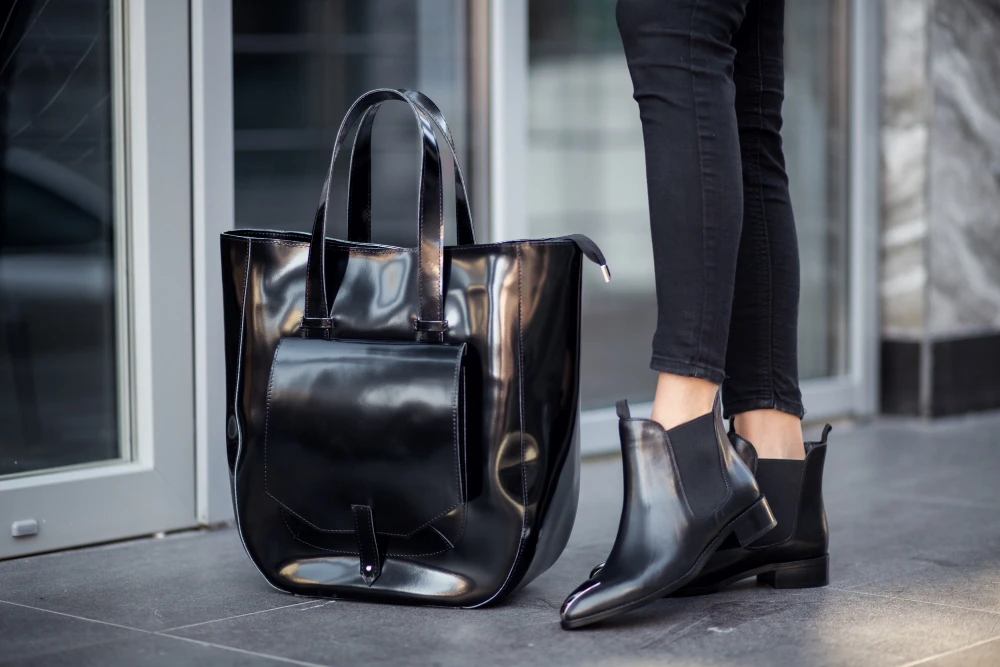
Matching accessories remain effective for formal events, restrained office dressing and monochromatic outfits. The result feels current when the colour is repeated but another characteristic changes. Black smooth-leather loafers, for example, can be paired with a black soft-grain shoulder bag. The shared colour creates order, while the different surface prevents the combination from looking like a preassembled set.
Use an exact match when:
- The clothing already contains several colours or a prominent print.
- The occasion calls for a controlled and formal appearance.
- The outfit is monochromatic, but its fabrics and silhouettes provide enough variation.
- The shoes and bag are visually simple and do not compete through oversized hardware or decoration.
Creative director Maj-La Pizzelli describes the relationship clearly: “The clothes are the canvas, and the accessories are the actual art.” The point is not that every accessory must dominate, but that each one should have a deliberate role. The shape and surface of items can be assessed more realistically in PASSAGE short-form product videos.
Contrast looks intentional when one detail connects the colours
Different colours work well when the outfit contains a visual bridge. Brown shoes and a navy bag may be connected by a patterned scarf, a belt, jewellery or a colour already present in the clothing. Without that bridge, two strong accessories can appear unrelated. With it, the contrast looks planned.
Fashion editor Nikki Chwatt has described compulsory shoe-and-bag matching as a “dated fashion rule.” Her examples include black boots with a brown bag, beige suede flats with black leather and tan suede paired with black pumps. These combinations work because the colours are supported by neutral clothing and the materials have a clear relationship.
Four low-risk contrast formulas
- Neutral shoes with a coloured handbag.
- Dark footwear with a lighter bag from the same temperature range.
- Two different accessory colours repeated in a scarf or printed garment.
- Contrasting colours connected through similar materials or understated hardware.
Street-style examples are easier to understand in motion and at full-body scale. The short-video section on Mytrade.kz can be used to compare how accessory colours behave with different silhouettes.
Tonal combinations offer more flexibility than perfect duplicates
A tonal pairing uses shades from the same colour family without requiring them to be identical. Chocolate brown can work with caramel, graphite with black, burgundy with muted red, and cream with beige. This method creates continuity while avoiding the overly coordinated effect that sometimes occurs when colour, material and finish all match.
Earlier colour-harmony experiments referenced in the Fashion and Textiles paper included 1,431 colour pairs rated on a scale from 1 to 10. Another study asked 20 observers to assess 58 shirt-and-trouser combinations. The results reinforce a practical point: colour harmony depends on context and perception rather than on sameness alone. In the newer research, one traditional model had a correlation of only 0.166 with contemporary observer ratings.
For daily use, tonal coordination is often easier to repeat across seasons. A warm brown bag may work with tan loafers, dark boots and cream trainers, giving one accessory more potential combinations. New guides and product-related materials are available in the PASSAGE news and offers section.
Texture and scale can matter more than colour
Two items may share an identical shade and still feel mismatched if their visual weight is different. Heavy platform boots paired with a very small formal clutch may create an imbalance, while loafers and a medium structured bag usually share a similar level of formality. InStyle presents 13 modern ways to coordinate shoes and handbags, including colour gradients, shared fabrics, patterns, occasion, weather and proportion.
Shoe-industry specialist Sarah Zurell advises: “Aim for materials that complement each other.” This does not require using the same material. Suede can soften polished leather, woven fabric can lighten summer footwear, and a matte bag can balance glossy shoes. The decision should be based on whether the textures support the same mood.
Check these elements before buying
- Compare the accessories in natural and artificial light.
- Photograph the complete outfit rather than assessing each item separately.
- Check whether both accessories are competing to become the main focal point.
- Consider whether their size and structure suit the clothing silhouette.
- Test the new item with at least three outfits already in the wardrobe.
The three-outfit test prevents single-use purchases
Before choosing a handbag because it perfectly matches one pair of shoes, build three realistic combinations: one for work, one for an informal day and one for an evening or social occasion. If the item functions in at least two scenarios, it is likely to have greater practical value. If it requires another new purchase before it can be worn, the apparent match may be too narrow.
The same approach applies when comparing products from different sellers. The Mytrade.kz marketplace provides a broader view of available categories, helping shoppers compare colours, materials and product types before deciding. At PASSAGE, the useful question is not simply whether the bag matches the shoes, but how many complete outfits the combination can support.
A coordinated wardrobe leaves room for variation
A handbag does not have to be the same colour as the shoes. Exact matching can organise a formal or visually busy outfit, tonal shades provide everyday flexibility, and controlled contrast brings character to neutral clothing. PASSAGE shoppers can make a more practical decision by considering colour temperature, texture, scale and existing wardrobe combinations together. The previous guide on pairing a handbag with shoes without creating a predictable set explores additional ways to keep accessories connected without making them identical.